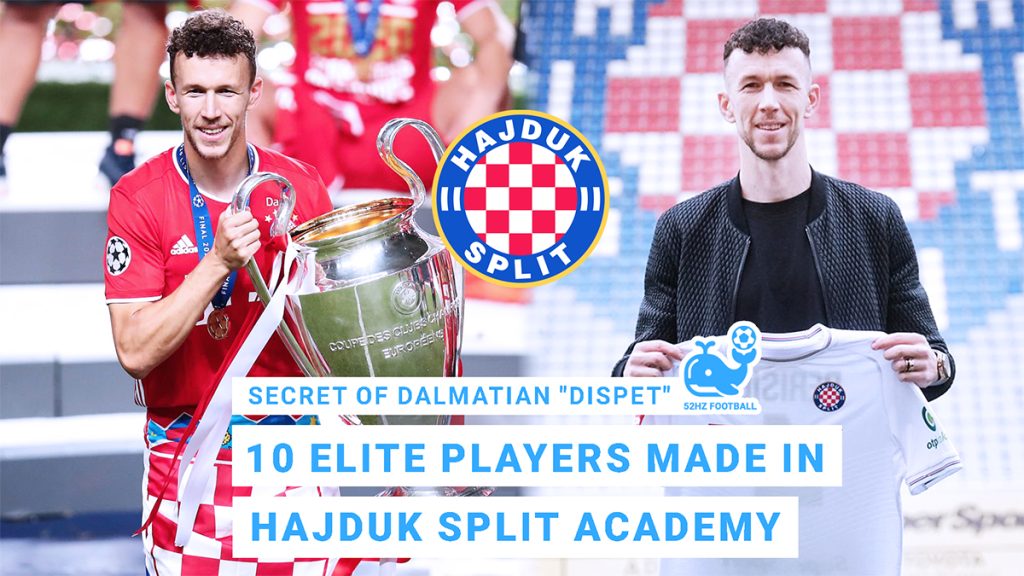
Who are the greatest players produced by the Hajduk Split academy? From Ivan Perišić and Darijo Srna to modern favourite Marko Livaja, these are ten of the finest footballers developed at Poljud.
Dinamo Zagreb may receive more attention for its transfer business, but Croatia’s other great talent factory sits on the Dalmatian coast. The Hajduk Split academy has helped develop World Cup medallists, Champions League winners and players who became major figures across Europe.
The academy’s identity is closely connected to Split and to the idea of dišpet: a particularly Dalmatian mixture of pride, defiance and determination. It is not an official coaching method, but the word captures the mentality commonly associated with Hajduk and its supporters.
This ranking considers each player’s senior career, international record, major honours and importance to Hajduk. It includes footballers who spent significant formative years in the club’s youth system, even if they arrived during their teenage years.
Last updated: 20 September 2026.
10. Stipe Pletikosa
Stipe Pletikosa entered Hajduk’s youth system as a child and made his senior debut in 1996. He established himself as the club’s first-choice goalkeeper before moving to Shakhtar Donetsk alongside Darijo Srna in 2003.
His career later included spells with Spartak Moscow, Rostov, Tottenham Hotspur and Deportivo La Coruña. Although he did not make a Premier League appearance during his loan at Tottenham, he enjoyed long and successful periods in both Croatia and Russia.
Pletikosa’s strongest claim to a place on this list is his international record. He won 114 caps for Croatia, appeared at five major tournaments and remained the national team’s leading goalkeeper for much of the period between the 2002 and 2014 World Cups.
Vedran Runje was another respected goalkeeper developed by Hajduk, but Pletikosa’s longevity and international career make him the stronger top-ten choice.
9. Marko Livaja
Marko Livaja joined Hajduk’s youth setup as a teenager before moving to Italy in 2010. Inter Milan recognised his potential early, although his subsequent career took him through several clubs and countries.
Livaja represented Inter and Atalanta in Serie A, played for Rubin Kazan and Las Palmas, and enjoyed a particularly productive spell with AEK Athens. His talent was rarely in question, but it was his return to Split that finally gave his career a permanent home.
After rejoining Hajduk in 2021, Livaja became the central figure in the team. He won the Croatian league’s scoring title, helped the club lift consecutive Croatian Cups and built an unusually strong relationship with the supporters.
Livaja also scored against Canada at the 2022 World Cup and was part of the Croatia squad that finished third. As of September 2026, he remains a Hajduk player and one of the defining figures of the club’s modern era.
8. Nikola Vlašić
Nikola Vlašić entered the Hajduk Split academy in 2010 and made his first-team debut at 16. His strength, close control and powerful shooting quickly made him one of the most highly rated Croatian players of his generation.
Vlašić performed well against Everton in a Europa League qualifier in 2017 and joined the English club soon afterwards. His time on Merseyside did not work out, but a move to CSKA Moscow allowed him to rebuild his career.
He became one of CSKA’s leading attacking players before returning to the Premier League with West Ham United. Vlašić subsequently moved to Torino, initially on loan and then permanently.
At international level, he has represented Croatia at major tournaments and was part of the squad that claimed a bronze medal at the 2022 World Cup.
7. Nikola Kalinić
Nikola Kalinić joined Hajduk’s academy as a child and developed into a technically capable centre-forward. After scoring regularly for the senior team, he moved to Blackburn Rovers in 2009.
His best football came later in Italy. Kalinić scored consistently for Fiorentina and also represented AC Milan, Roma, Atlético Madrid and Hellas Verona. He won the 2018 UEFA Super Cup during his time with Atlético.
His international career ended in controversial circumstances at the 2018 World Cup. Kalinić was sent home after declining to enter Croatia’s opening match as a substitute, meaning he missed the remainder of the team’s run to the final.
He later returned to Hajduk and attracted worldwide attention by signing a contract worth a symbolic €1 for the remainder of the 2023/24 season. Kalinić retired in 2024 and briefly served as Hajduk’s sporting director.
6. Mario Pašalić
Mario Pašalić joined the Hajduk academy in 2006. After breaking into the first team, the midfielder was signed by Chelsea in 2014 but never played a competitive match for the London club.
Loans at Elche, Monaco, AC Milan, Spartak Moscow and Atalanta gave him experience in several major European leagues. Atalanta eventually signed him permanently in 2020, ending six years of uncertainty over his club future.
Pašalić developed into an unusually productive midfielder in Bergamo. His movement into the penalty area and ability to score important goals made him valuable under Gian Piero Gasperini.
The biggest club achievement of his career came in 2024, when Atalanta defeated Bayer Leverkusen in the Europa League final. Pašalić remains with the Italian club and has also represented Croatia at multiple major tournaments.
5. Igor Tudor
Before becoming a coach, Igor Tudor was one of the most accomplished defenders to emerge from Hajduk Split.
Tudor made his senior debut for Hajduk in the mid-1990s and joined Juventus in 1998. His height, aggression and tactical versatility allowed him to operate as a centre-back, full-back or defensive midfielder.
He won two Serie A titles with Juventus and played in the 2003 Champions League final. Tudor was also a member of the Croatia squad that finished third at the 1998 World Cup.
Injuries affected the later years of his career, but he eventually returned to Hajduk and retired in 2008. He subsequently managed the club during two separate spells before building a coaching career elsewhere in Europe.
4. Robert Jarni
Robert Jarni was one of the finest left-sided players of his Croatian generation. He arrived at Hajduk as a teenager and became part of a celebrated team that won the final Yugoslav Cup in 1991.
Jarni then moved to Bari and went on to represent Torino, Juventus, Real Betis and Real Madrid. His speed allowed him to play as a left-back, wing-back or midfielder.
He earned 81 caps for Croatia and played an important role at the 1998 World Cup. His long-range goal opened the scoring in the famous 3-0 quarter-final victory over Germany.
Jarni later returned to Poljud as Hajduk’s head coach during the 2007/08 season.
3. Alen Bokšić
Alen Bokšić was among the most powerful and technically gifted European forwards of the 1990s. After developing at Hajduk, he helped the club win the 1991 Yugoslav Cup before leaving for France.
His first transfer to Cannes did not produce immediate success, but his career changed at Marseille. Bokšić helped the French club win the 1993 European Cup and finished fourth in that year’s Ballon d’Or vote.
He later played for Lazio, Juventus and Middlesbrough, winning Serie A with both Juventus and Lazio. At his best, his combination of speed, strength and close control made him extremely difficult to defend.
Bokšić earned 40 caps for Croatia. A knee injury ruled him out of the 1998 World Cup, however, so he did not take part in the country’s historic bronze-medal campaign.
2. Darijo Srna
Darijo Srna moved into Hajduk’s system as a teenager and made his senior debut in 1999. His energy, crossing and set-piece delivery soon established him as one of Croatian football’s leading young players.
Srna joined Shakhtar Donetsk in 2003 and remained there for 15 years. He became the club’s captain and one of the most important players in its history, winning ten Ukrainian league titles and the 2009 UEFA Cup.
He was equally influential for Croatia. Srna made 134 international appearances, captained the national team and held the country’s appearance record until Luka Modrić surpassed him.
His achievements, leadership and longevity make him one of the two strongest candidates for first place in any ranking of Hajduk academy graduates.
1. Ivan Perišić
Ivan Perišić takes first place because of the scale and variety of his career at both club and international level.
Perišić joined Hajduk’s youth system around the age of 11 after beginning his development with Dalmatinac Split. He left for Sochaux in 2006, aged 17, before making a competitive appearance for Hajduk’s senior team.
After emerging at Club Brugge, where he became the Belgian league’s top scorer, Perišić played for Borussia Dortmund, Wolfsburg, Inter Milan, Bayern Munich and Tottenham Hotspur.
His honours include the Bundesliga with Dortmund, a treble with Bayern in 2019/20 and the Serie A title with Inter. He also scored in the 2018 World Cup final and helped Croatia finish third four years later.
Perišić finally returned to Hajduk in January 2024 while recovering from an anterior cruciate ligament injury. His loan became a permanent move after his Tottenham contract expired, but the homecoming lasted only a few months. Hajduk and Perišić ended their agreement in August 2024, and he joined PSV the following month.
He subsequently helped PSV win consecutive Eredivisie titles and, as of September 2026, remains with the Dutch club. The brief Hajduk return did not unfold as supporters had imagined, but it finally gave Perišić the senior appearance for his hometown club that had been missing from his career.
Frequently Asked Questions
Who is the greatest player produced by the Hajduk Split academy?
Ivan Perišić is the strongest overall candidate. He won league titles in Germany, Italy and the Netherlands, lifted the Champions League with Bayern Munich and played a central role in Croatia’s runs to the 2018 and 2022 World Cup podiums.
Who is the most expensive player sold by Hajduk Split?
Luka Vušković holds the club record. Tottenham Hotspur agreed to sign the 16-year-old defender from Hajduk in 2023 for a reported fee of approximately €11 million, or £12 million. The transfer formally took effect in 2025 when Vušković was old enough to move to England.
Did the Hajduk Split academy produce any elite goalkeepers?
Yes. Stipe Pletikosa is its leading goalkeeping graduate. He earned 114 Croatia caps and represented the country at five major tournaments. Vedran Runje, who played for Standard Liège, Marseille, Beşiktaş and Lens, is another notable academy product.
Did Ivan Perišić play for Hajduk Split’s first team?
Perišić did not make a competitive first-team appearance before leaving the academy for Sochaux in 2006. He finally represented Hajduk’s senior side after returning in 2024, scoring once in eight Croatian league appearances across his loan and permanent spells.
What does “dišpet” mean?
Dišpet is a Dalmatian expression describing pride, stubbornness and the determination to resist or succeed when challenged. It is frequently associated with the identity of Split, Hajduk and the club’s passionate Torcida support.
You have just read “10 Elite Players Made in the Hajduk Split Academy”. Follow 52Hz Football for more stories about football, geography and culture.
Read More
- Dinamo Zagreb Academy: The Factory That Made Modrić, Gvardiol and Kovačić
- The Marakana Factory: 10 World-Class Stars Forged at Red Star Belgrade
- The Other Balkan Factory: 10 Stars Made at Partizan Belgrade
- Why Are So Many Football Clubs Called Dynamo or Dinamo?
