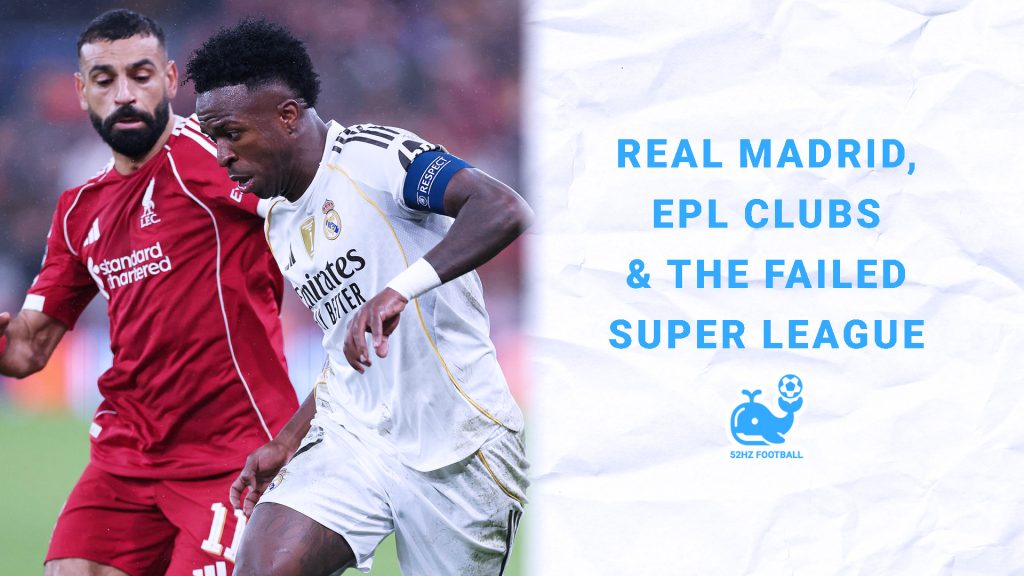
The European Super League never staged a match, yet its financial consequences are still being argued over five years after its launch. Real Madrid now wants the six English founders to share the Super League costs.
That raises a reasonable question: if those clubs abandoned the competition almost immediately, why might they still owe money?
The answer turns on the difference between withdrawing from a sporting project and being released from the agreements behind it. Madrid says financial obligations remain. Establishing what those obligations actually require is the difficult part.
Updated: 21 October 2026.
READ MORE:
Is Barcelona Actually Poor? What the Club’s Financial Accounts Reveal
What Is Real Madrid Actually Asking For?
On 20 October, Madrid confirmed to Reuters that it was seeking contributions from Arsenal, Chelsea, Liverpool, Manchester City, Manchester United and Tottenham Hotspur. The six withdrew within days of the Super League’s announcement in 2021.
Madrid says the costs of establishing the competition have so far been covered by Real Madrid, Barcelona and Juventus. Its position is that the English founders should also bear a share.
The Athletic reported an estimate of up to €80 million in total initial costs. That is an estimate of expenditure, rather than a court-approved award or a published invoice establishing each club’s liability.
A Madrid source cited in the reporting also said contributions would be payable to the European Super League Company. That matters: a company receiving funding and Madrid directly receiving compensation are different financial transactions.

Why Were the Clubs Willing to Sign Up?
The original April 2021 announcement helps explain why the founders entered into a joint venture in the first place.
The proposed competition would have 20 teams: 15 founding members and five annual qualifiers. Matches would take place in midweek, while clubs continued playing in their domestic leagues. The founders presented it as a response to financial instability, intensified by the pandemic.
Their announcement also envisaged €3.5 billion for the founding clubs collectively, intended for infrastructure investment and the impact of COVID-19. This was a proposal for future funding, not proof that every club received its allocation.

The format suggests a straightforward commercial attraction: more predictable participation and income from recurring fixtures between major clubs. The protected position of founders was also central to the controversy.
The significance for today’s dispute is that the Super League was organised as a shared business undertaking. The clubs’ involvement extended beyond publicly endorsing an idea. The obligations attached to that undertaking are now the focus.
Why Might Withdrawal Leave Financial Obligations Behind?
From a supporter’s perspective, withdrawal sounds decisive: a club announces it is leaving, and its involvement ends.
For a business arrangement, the questions are more specific. What was signed? When did obligations arise? What procedure governed withdrawal? Did an exit release the club from existing commitments, future commitments, or both?
Those questions explain Madrid’s argument without proving it correct.
READ MORE:
Why Is the Champions League Played in Midweek Instead of Weekends?
Consider a hypothetical joint project. Several organisations approve preparatory work and agree how to finance it. If some later withdraw, a statement announcing their departure would not, by itself, show whether previously agreed bills had been cancelled.
The opposite possibility also matters. If continuing participants commission additional work after others leave, charging the departing organisations for that later expenditure would raise further questions about authority and consent.
These are analytical examples, not a description of provisions verified in the Super League agreement. They illustrate why the timing and terms of the commitments matter more than the announcement of withdrawal alone.
Where Does Madrid’s Argument Become More Difficult?
The reported shareholders’ agreement is the key document. According to The Athletic’s reporting, summarised by Insider Sport, it committed the founding clubs to jointly owning and managing the company.
However, the documents made public so far reportedly do not explicitly specify the cost-sharing obligation Madrid is asserting.
That gap matters. Owning part of a project, agreeing to provide funding, and promising to reimburse particular expenditure are different propositions. An assessment would need to identify which commitments the clubs actually made.
Four practical questions would help readers assess any eventual claim.
First, what does the total include? Preparatory spending, later operating expenses and litigation costs would need to be identified rather than treated as one unexplained figure.
Second, when was the spending approved and incurred? Work authorised before withdrawal could raise different issues from work commissioned years later.
Third, how would the amount be allocated? An equal division among 12 founders is a mathematical illustration, not evidence of the contractual formula.
Fourth, who is entitled to collect? The company’s position and any reimbursement arrangements with clubs that advanced funds would need to be distinguished.
These are questions the available reporting leaves open. A headline figure cannot answer them.

How Much Could Each English Club Owe?
There is no publicly established per-club amount in the reporting used for this article.
For scale, dividing €80 million equally among 12 founders produces approximately €6.67 million each. Six such shares would total €40 million.
But that calculation makes two assumptions: that the full €80 million qualifies for recovery, and that all 12 clubs bear equal shares. Neither assumption has been established.
The actual allocation could depend on commitments, prior contributions, releases or other terms that have not been demonstrated publicly.
The calculation is therefore useful only for understanding scale. It should not become a report that each English club has been ordered to pay €6.67 million.
Didn’t They Already Agree to Pay After the Collapse?
Yes. The English clubs agreed to financial measures with football authorities in 2021.
In June, the Premier League and the FA announced a collective £22 million contribution supporting fans, grassroots football and community programmes. Their statement said the agreement concluded both organisations’ investigations.
It also provided for a 30-point deduction and an additional £25 million fine for each club if similar actions occurred again. That £25 million figure described a future consequence under the arrangement, not the amount imposed on each club for joining in 2021.
UEFA separately agreed reintegration measures with nine departing founders. These included a combined €15 million donation and withholding 5% of their UEFA club-competition revenues for one season.
Those announcements dealt with the clubs’ relationship with football authorities. They did not publicly resolve every possible obligation between the shareholders of the Super League company.
The important distinction is the recipient and the purpose of each payment. Settling an investigation with a league does not demonstrate that another company’s contractual claim has also been settled. That would require examining the relevant agreements and releases.
READ MORE:
What About Madrid’s Demand for Billions From UEFA?
That was a separate dispute over alleged damage caused by UEFA’s opposition to the competition.
In October 2025, Madrid announced that a Spanish appeal ruling opened the way to substantial compensation claims. It said it would request damages from UEFA.
The Financial Times reported that experts hired by Madrid estimated lost revenues of between €4.5 billion and €4.7 billion. Those figures represented an assessment supporting Madrid’s position, not money a court had awarded.
The distinction from the latest demand is substantial. Seeking a contribution towards expenditure asks who agreed to finance costs already incurred. Seeking damages for lost revenue asks whether another party’s unlawful conduct caused a recoverable loss.
The sums cannot sensibly be combined into one Super League bill.
| Financial issue | What the money concerns |
|---|---|
| Reported costs of up to €80 million | Funding the Super League project |
| The 2021 Premier League and UEFA measures | Settlements with football authorities |
| Madrid’s UEFA damages position | Alleged losses from opposition to the project |
Different obligations, recipients and evidence sit behind each category.
Didn’t Madrid Already Win the Court Case?
Madrid and the Super League company secured significant decisions against football’s governing bodies. Those decisions need to be understood within their scope.
In December 2023, the Court of Justice of the European Union found that FIFA and UEFA’s approval and sanctioning rules lacked a framework ensuring transparent, objective, non-discriminatory and proportionate decision-making.
The concern included the conflict created when organisations that run competitions also control whether potential competitors may enter the market.
However, the court expressly said its judgment did not mean the Super League necessarily had to be approved. It had been asked about the governing bodies’ rules, rather than to endorse that particular competition.
For the latest payment dispute, the limitation is straightforward: that judgment did not decide what each founding club owed under its shareholders’ agreement.
Success in a competition-law dispute therefore does not establish success in a separate dispute over contributions to project costs.
Does the 2026 Agreement With UEFA End Everything?
On 11 February 2026, UEFA, European Football Clubs and Real Madrid announced an agreement of principles.
Their statement linked it to sporting merit, club sustainability and improving the fan experience. It also said their Super League-related legal disputes would be resolved once the principles were executed and implemented.
That conditional wording matters. The announcement should not be expanded into proof that every agreement involving every founder had been cancelled or that all possible financial claims had disappeared.
A settlement concerning Madrid’s relationship with UEFA and a dispute concerning contributions from former project partners address different relationships.
The public statement does not establish the answer to the shareholder-cost question.
What Would Demonstrate That Madrid Is Actually Getting Paid?
The next meaningful development would be evidence establishing an obligation and an amount: an agreed settlement, a disclosed payment commitment, or a decision ordering a contribution.
Until then, reporting should distinguish Madrid requesting payment from clubs accepting liability or a court enforcing it.
A formal claim would also allow closer scrutiny of the expenditure being sought, the contractual basis and the proposed allocation. Those details would tell readers far more than another repetition of the €80 million headline.
Madrid has a position it wants recognised. The English clubs’ precise obligations remain unestablished in the reporting available.
The Super League’s sporting collapse was rapid. Resolving the business commitments behind it is a different process, and the surviving paperwork may matter more than the tournament that never began.
You have just read “Why Is Real Madrid Asking Premier League Clubs to Pay for the Failed Super League?” Follow 52Hz Football for more answers to the questions behind the game.
