
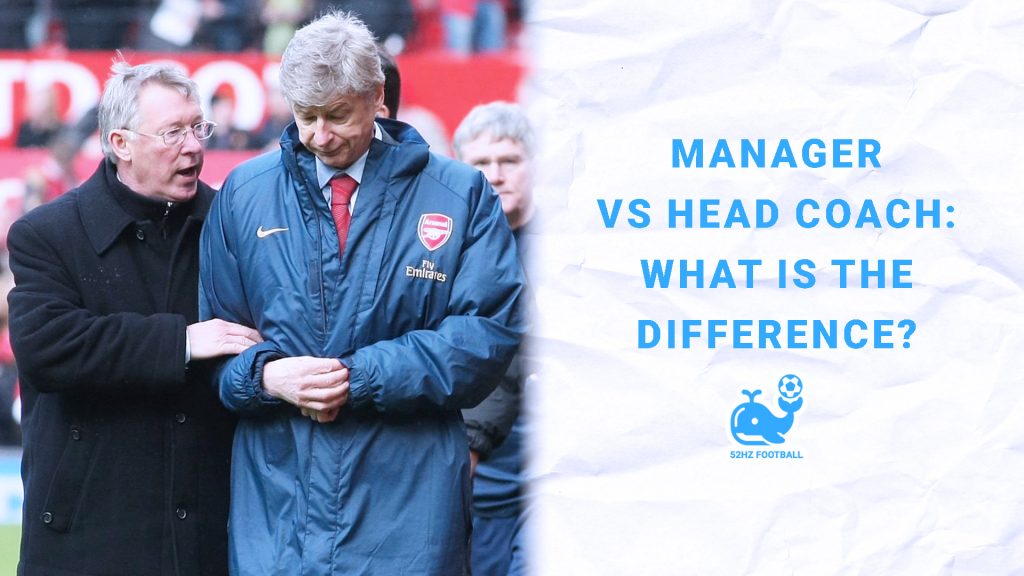
The difference between a football manager and a head coach is mainly the amount of control each person has beyond the first team. Both can run training, select the starting XI and make tactical decisions, but a manager traditionally has a wider influence over recruitment, staff and the club’s long-term football plan.
Football uses the two titles loosely. One club may appoint a manager while another gives an almost identical job to a head coach. The wording matters less than the authority written into the role.
1. Football Manager vs Head Coach
A head coach is primarily responsible for improving the available players and producing results with the first team. A manager normally performs those duties too, but may also help shape transfers, staffing, academy pathways and long-term squad planning.
There is no universal definition. A powerful head coach can control more than a manager at another club, so the internal structure must always be considered.
| Area | Manager | Head coach |
|---|---|---|
| Training and tactics | Leads or oversees | Primary responsibility |
| Team selection | Usually controls | Usually controls |
| Transfers | Often has strong influence | Usually works within a club-led process |
| Coaching staff | May appoint much of the staff | May inherit some club appointments |
| Long-term planning | Can have a wider role | Usually focused on the first team |
| Reports to | Owner, chairman or chief executive | Often a sporting director or football executive |
READ MORE:
2. What Is a Football Manager?
The traditional football manager is the senior authority on the sporting side of a club. He or she coaches the team and handles matches while also influencing how the squad is built.
This does not mean the manager personally negotiates every fee or contract. Executives usually handle that work. The distinction is influence: a manager may identify targets, approve departures, choose senior staff and shape the academy’s direction.
Notable Football Managers
- Sir Alex Ferguson – Manchester United: the clearest example of a manager whose authority extended across the first team, recruitment and long-term planning.
- Arsène Wenger – Arsenal: combined coaching with transfer influence, youth development and major input into the club’s football direction.
- Jürgen Klopp – Liverpool: carried the manager title, although recruitment was shared with a specialist sporting department.
- Pep Guardiola – Manchester City: another manager who worked successfully alongside a director of football.
That concentration of power is rarer today. Elite clubs now employ large recruitment, data, medical and performance departments, making football decisions more collaborative.
3. What Is a Head Coach?
A head coach is hired chiefly to make the first team perform. The job covers training, tactics, selection, player development and match preparation.
Recruitment may still involve the coach, but a sporting director or recruitment department normally leads the process. The coach can request a position, describe the required player profile, assess a shortlist and sometimes reject a proposed signing. The club nevertheless owns the wider plan.
This structure allows a team to change its coach without rebuilding the entire football department. If recruitment and academy planning remain consistent, the club can find a replacement suited to the same general style.
Notable Head Coaches
- Thomas Tuchel: held the head-coach title at clubs including Chelsea and Bayern Munich.
- Hansi Flick: has been described as head coach with Bayern Munich, Germany and Barcelona.
- Julian Nagelsmann: worked as head coach at RB Leipzig, Bayern Munich and the German national team.
- Arne Slot: Liverpool appointed him as head coach in 2024, after Jürgen Klopp had been known as manager.
4. Where Does the Sporting Director Fit In?
The rise of sporting directors helps explain the increased use of the head-coach title. This executive usually oversees recruitment, scouting, squad planning and the broader football strategy, leaving the head coach to concentrate on the team.
The Premier League’s guide to sporting directors stresses that responsibilities vary between clubs. In a simplified model, the board sets the budget, the sporting director builds the squad and the coach works with it. Successful clubs still make major decisions together.
Confusion begins when the boundaries are unclear. A coach may believe a signing does not suit the system, while the recruitment department may view that player as important to the club’s longer-term plan.
Notable Sporting Directors
- Monchi – Sevilla: one of Europe’s best-known recruitment executives and closely associated with Sevilla’s transfer model.
- Michael Edwards – Liverpool: served as sporting director during much of the successful Klopp era.
- Txiki Begiristain – Manchester City: worked as director of football for 13 years and helped build the squad around Guardiola.
- Hasan Salihamidžić – Bayern Munich: progressed from sporting director to the club’s executive board for sport.
READ MORE:
The Hidden Cost of Official Football Shirts: £100 Kits and £1-an-Hour Workers
5. Where Are Managers, Head Coaches and Sporting Directors Most Common?
The language changes from one football culture to another. These are broad patterns rather than fixed rules, and individual clubs can choose any title they prefer.
| Region | Most familiar title | Typical structure |
|---|---|---|
| England, Scotland and Ireland | Manager | The traditional manager remains familiar, although head coaches and sporting directors are increasingly common. |
| Germany | Head coach | The coach normally works alongside a sporting director or board member responsible for sport. |
| Spain, Italy, France and Portugal | Coach or head coach | Coaching and recruitment are usually separated, with a sporting or technical director above the squad-building process. |
| North America | Head coach | Clubs commonly pair a head coach with a general manager or sporting director, following the language of other American sports. |
| South America | Coach or director técnico | In Spanish-speaking countries, director técnico usually means the coach rather than an executive technical director. |
| Asia and Africa | Head coach or manager | Usage varies widely. Head coach is common for national teams, while larger clubs increasingly employ directors of football. |
6. Why Did English Clubs Traditionally Use Managers?
English football developed around one person running most of the sporting operation. The board handled the business, while the manager controlled the team and had a large say in the people around it.
Long reigns made the model effective. A manager who stayed for a decade could build a scouting network, develop young players and refresh the squad in stages. Supporters also came to associate the identity of a club with its manager.
Many continental clubs separated the jobs earlier. In Germany, the head coach commonly works alongside a sporting director who provides continuity above the first team. The Bundesliga’s explanation of the role shows how coaching and wider football management can be divided.
7. Why Do Modern Clubs Prefer Head Coaches?
The head-coach model reduces dependence on one individual. Recruitment can continue when the coach changes, academy teams can follow shared principles and expensive long-term contracts do not have to reflect one person’s preferences.
It also matches the complexity of elite football. Scouting, analytics, sports science, loans and contract planning all require specialist staff. Asking one manager to control every department is no longer realistic at many clubs.
The system is not automatically better. It works only when the coach understands the recruitment strategy and executives respect the team’s tactical needs. Divided responsibility without clear accountability can create more problems than it solves.

8. Does the Title Reveal Who Has More Power?
Not necessarily. Someone called head coach may have a decisive voice in transfers and staffing. A person called manager may work beneath a sporting director and have limited recruitment control.
Jürgen Klopp was Liverpool’s manager, but recruitment involved sporting executives and specialist staff. Pep Guardiola has carried the manager title while working within Manchester City’s wider football structure. Modern clubs often blend the two models rather than following either one perfectly.
The useful questions are therefore practical: Who controls the budget? Who chooses transfer targets? Who appoints staff? Which decision-makers remain when the first-team leader leaves?
9. Can a Head Coach Sign Players?
A head coach can influence signings but rarely completes them alone. Scouts and analysts assess options, while executives negotiate with clubs, players and agents.
Some coaches have a veto; others choose from a shortlist or are merely consulted. Managers may possess more influence, but they also operate within a budget and need board approval. It is more accurate to say that recruitment belongs to the club, with the coach contributing according to the power of the role.
10. What Is the Difference Between a Coach and a Head Coach?
Coach is a broad term. A club may employ assistant, goalkeeper, fitness and set-piece coaches, each responsible for a particular area.
The head coach leads that group and carries final responsibility for the first team. People often shorten head coach to coach, especially outside Britain. This is why an American fan may say coach while an English fan calls a similar figure the manager.

11. Are International Managers Different?
National teams also use both titles, but the distinction matters less because there is no transfer market. The person in charge selects eligible players, prepares them during short camps and leads them in matches. In international football, manager and head coach are usually alternative labels for nearly the same job.
12. Football Manager vs Head Coach: Final Verdict
A football manager traditionally combines coaching with broader control of the sporting operation. A head coach focuses more closely on preparing and leading the first team within a structure managed by other executives.
That is a useful guide, not a strict rule. To learn who really runs a team, look beyond the title and ask who controls recruitment, appoints staff and sets the long-term plan.
Frequently Asked Questions
Is a football manager higher than a head coach?
Not automatically. Manager usually suggests a broader role, but the actual hierarchy and contract determine how much authority the person has.
Can a club have both a manager and a head coach?
It is unusual because their first-team duties would overlap. Clubs more commonly pair a manager with specialist coaches or a head coach with a sporting director.
Why do Americans say coach instead of manager?
Coach is the standard term for the person leading a team in most major American sports. That convention also carries into soccer.
You have just read “Football Manager vs Head Coach: What Is the Difference?”. Follow 52Hz Football for more answers to the questions behind the game.
