An awkward handshake, arguments over service and accusations against other Portugal players have sustained the idea of a rift. The public record tells a more complicated story.
On 3 October 2026, Bruno Fernandes used a Portugal press conference to defend Cristiano Ronaldo. He said he had spoken to his absent team-mate, described him as the country’s greatest footballing symbol and rejected suggestions that the national team had split into opposing camps. He asked for the country to stop dividing itself over the dispute.
It was a substantial public intervention from someone repeatedly cast as Ronaldo’s antagonist. Fernandes was not merely declining to criticise him. He was arguing that Ronaldo’s standing deserved protection at a moment when the forward’s relationship with Portugal’s coaching staff had become a national controversy.
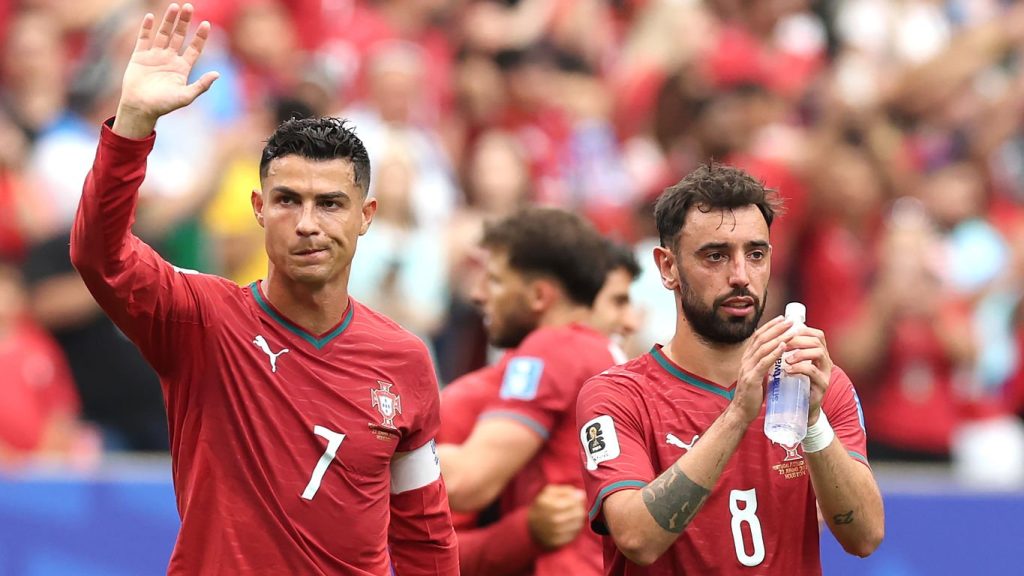
Six weeks later, the discussion has acquired fresh urgency. Ronaldo has retired from international football, and Portugal have lost 4-1 to Denmark in their first match since his announcement. There are legitimate questions about the team’s direction, its leadership and the consequences of moving beyond its most famous player. The defeat in Braga on 14 November supplies ample material for football analysis.
It supplies considerably less evidence about who hates whom.
The claim that Fernandes resents Ronaldo, refuses to serve him or lies behind dressing-room unrest requires more than an unhappy expression or an unsuccessful attack. It requires evidence of intent and influence. The publicly documented episodes most often associated with their relationship do not establish that case. Several point in the opposite direction.
This does not mean Fernandes must be an exemplary captain, or that every criticism of him is unfair. It means the criticism has to describe something that can actually be demonstrated.
The handshake that outlived its explanation
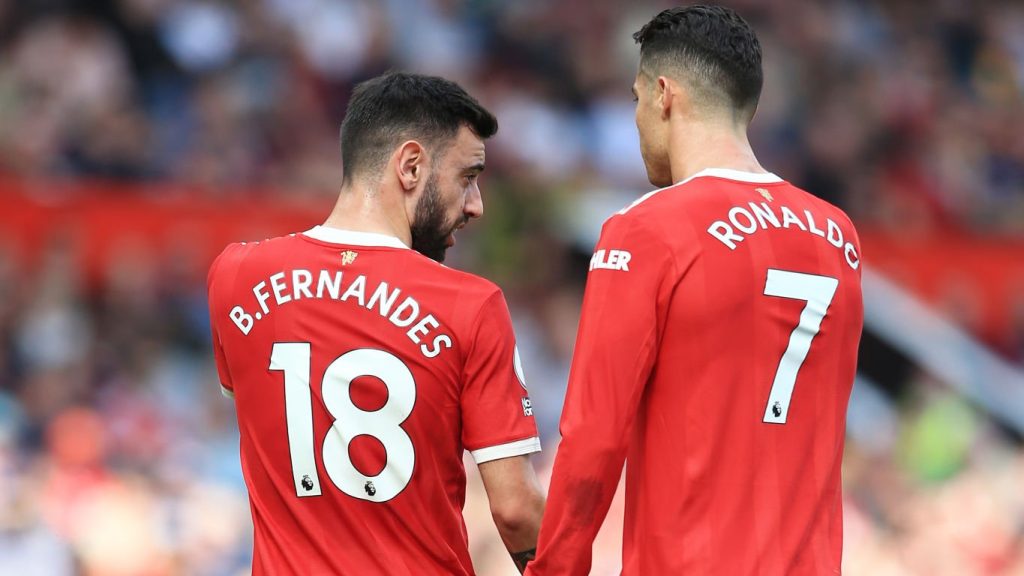
The most durable image of the supposed feud dates from November 2022. Ronaldo’s interview with Piers Morgan had placed his future at Manchester United in doubt. When Fernandes arrived at Portugal’s World Cup camp, a brief exchange between the two men appeared awkward. A handshake, a glance and a few seconds of body language were presented as evidence of a broken relationship.
The atmosphere around United made that interpretation easy to sell. The video itself did not establish it.
João Mário, who said he had been present, explained that Ronaldo had been teasing Fernandes about his late arrival and asking whether he had travelled by boat. Fernandes subsequently told Sky Sports that the exchange had been a joke, and criticised television coverage that had spent far longer discussing the apparent hostility than explaining the conversation once its sound became available.
More significantly, Ronaldo offered the same account. At his own press conference on 21 November, he described his relationship with Fernandes as “excellent” and repeated the joke about the delayed flight and travelling by boat. The explanation came from both players.
Public denials cannot certify the private feelings of two footballers. Players have professional reasons to avoid discussing disagreements. But dismissing the accounts of both men while treating an ambiguous clip as conclusive reverses the normal burden of proof.
The initial suspicion survives; the explanation becomes optional.
There was another revealing episode at the same tournament. Fernandes’s cross against Uruguay produced Portugal’s opening goal, which FIFA awarded to the midfielder after Ronaldo had celebrated as though he had supplied the final touch. Fernandes said afterwards that he had thought Ronaldo touched it and that he had been trying to find him. Adidas later said the ball’s technology showed no contact from Ronaldo.
That incident does not prove lifelong friendship either. It does, however, deserve a place in any honest assessment of a player supposedly consumed by denying Ronaldo recognition.
What Fernandes actually said about playing with Ronaldo
The football argument is more complicated than the feud story allows.
Portugal’s 9-1 win over Armenia in November 2025, with Ronaldo suspended and both Fernandes and João Neves scoring hat-tricks, gave renewed force to the question of whether the team functioned more freely without its captain. A result against one opponent could not settle every subsequent selection.
When Fernandes addressed that argument in an interview with Canal 11 the following month, his answer was strikingly measured. He recognised the perception that Portugal’s players looked less constrained without Ronaldo, but said that, if they allowed themselves to become inhibited by his presence, responsibility also belonged to them.

He then explained the different qualities available to the team: Ronaldo’s threat in the penalty area and ability to occupy defenders; Gonçalo Ramos’s pressing and diagonal movement; Bernardo Silva’s possession play compared with his own emphasis on the final pass.
It was an answer that allowed Ronaldo to remain valuable without pretending that his presence had no tactical consequences.
That distinction matters. A team changes when its centre-forward changes. The height of its pressure, the runs available beyond the ball and the positions from which chances are created can all change with him. Discussing those differences is ordinary football analysis.
It becomes much harder when every observation about the team is treated as a verdict on Ronaldo’s entire career.
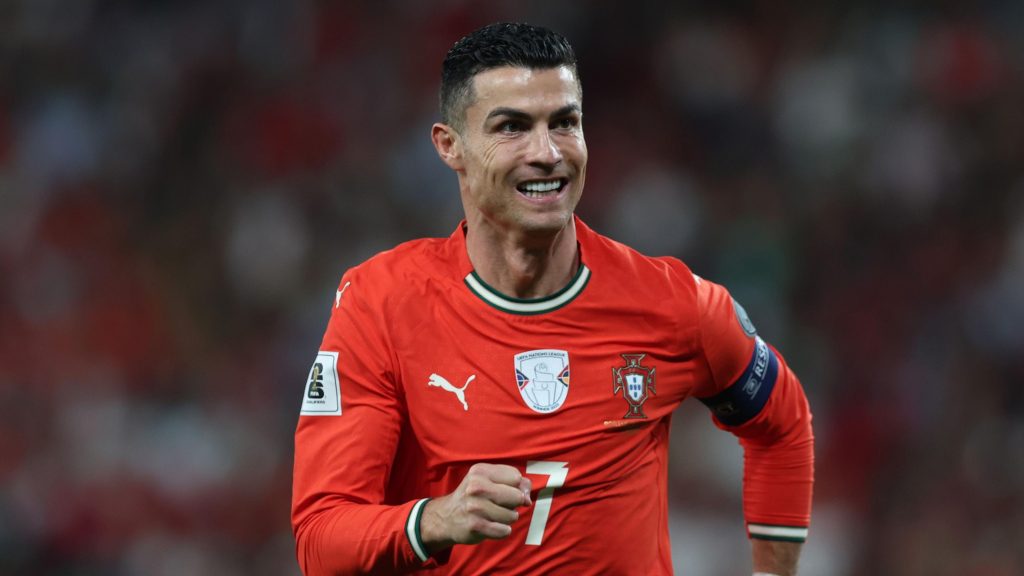
A midfielder can respect Ronaldo’s achievements while disagreeing with a pass he wants. A coach can prefer a different forward for a particular match without denying his historical importance. Fernandes can acknowledge the qualities of Ramos without making a declaration of hostility towards Ronaldo.
Conversely, a heavy victory without Ronaldo does not settle the selection debate on its own. Opponents, match conditions and the performance of the other ten players still matter. Reducing every result to Ronaldo’s presence or absence is an inadequate explanation whichever side benefits from it.
João Neves, Vitinha and the recurring accusation
Fernandes is not the only Portugal player to have been accused of failing Ronaldo.
After Portugal’s 1-1 draw with DR Congo at the 2026 World Cup, Portuguese reporting documented abusive comments directed at Fernandes, Vitinha and João Neves. The accusations included claims that team-mates were not passing to Ronaldo and demands that they show him greater respect.
Neves was also criticised for his post-match comments. Having acknowledged Ronaldo’s contribution, he described him as another member of the team there to help. Some supporters interpreted the emphasis on collective responsibility as a reduction of Ronaldo’s status. The reaction extended to his partner’s social-media account.
Here, the language of the reaction is revealing. Asking whether a midfielder overlooked a good passing option is a football question. Insisting that his responsibility is to run for a particular player, or interpreting an appeal to collective standards as disrespect, introduces a different expectation.
It makes personal deference part of the job.
There are occasions when Ronaldo has been available and a team-mate has chosen badly. Those decisions should be examined. The same applies when Fernandes forces a pass, holds the ball too long or overlooks a better-positioned forward.
But an unsuccessful decision does not establish a boycott. A sequence of selected clips cannot, by itself, explain what a player saw, what instruction he was following or whether the intended pass was technically available. A claim of deliberate exclusion requires evidence that ordinary performance criticism does not.

The range of targets is significant. With Fernandes, Vitinha and Neves all facing the accusation, there is reason to examine the expectation behind it as well as each player’s performance. Demanding that several different midfielders demonstrate their loyalty through their passing choices risks turning a tactical argument into a personal allegiance test.
That does not describe every Ronaldo supporter. His following is far too large and varied for such a generalisation. It does describe a documented strand of the reaction around Portugal, and it helps explain why Fernandes can remain a suspect even after publicly defending the man he is accused of undermining.
The context missing from Félix’s answer
João Félix belongs to this history of debate for a different reason.
In December 2022, after Portugal had beaten Switzerland 6-1 with Ronaldo starting on the bench, Félix was asked about José Fonte’s suggestion that players could feel an obligation to keep finding Ronaldo.
Félix said he did not feel that obligation. Read in isolation, the sentence could sound defiant. His explanation was considerably less dramatic: players should choose the best option available; Ronaldo supplied qualities that Portugal lacked when he was absent; other forwards supplied different ones. Félix explicitly resisted the idea that the team became automatically better or worse depending on Ronaldo’s presence.
That is not a refusal to pass to Ronaldo. It is a refusal to make the recipient’s identity the only consideration in a football decision.
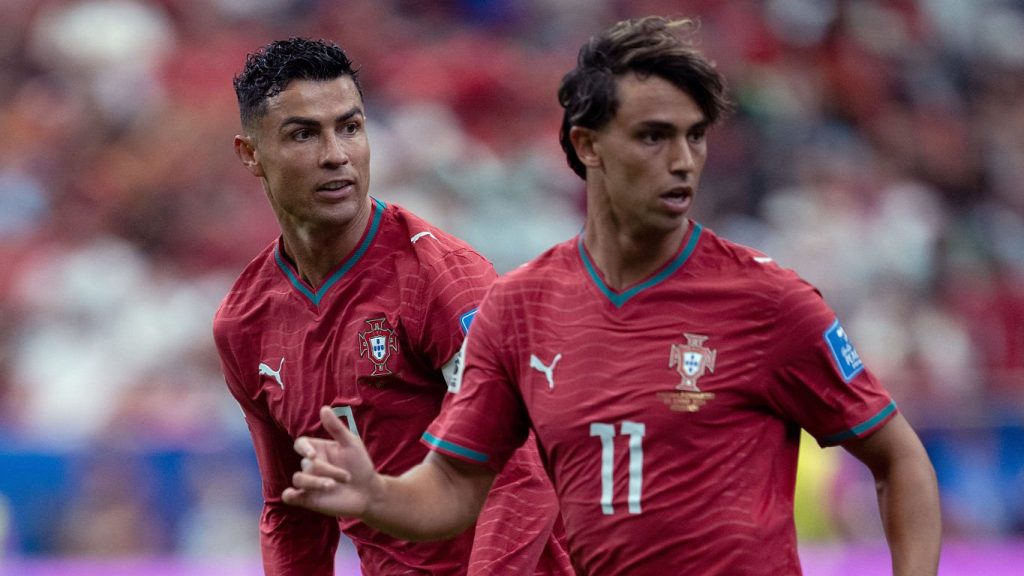
Félix’s words should not be used as evidence that he participated in an anti-Ronaldo faction. They show how easily a statement about decision-making can acquire a more confrontational meaning when the qualification disappears.
Rúben Neves, meanwhile, publicly rejected suggestions of dressing-room controversy at the 2022 World Cup and praised Ronaldo’s condition. He was defending the squad’s relationship with its captain. The Neves targeted in the documented backlash in 2026 was João.
Criticising Fernandes does not require a conspiracy
There is a serious case to be made against aspects of Fernandes’s leadership. His visible frustration can be distracting. Supporters can reasonably ask whether a captain’s gestures help colleagues recover from mistakes or make a difficult situation more agitated.
Roy Keane made that criticism forcefully after United’s 3-0 defeat by Manchester City in October 2023, arguing that Fernandes should lose the captaincy because of his behaviour despite his ability as a footballer.
That is an argument people can test against what happens on the pitch. It should not be inflated into a claim that Fernandes organises dressing-room disorder, forces out team-mates or secretly directs selection.
Being conspicuous during a bad period does not demonstrate responsibility for everything that goes wrong within it. A captain is routinely shown reacting to defeats and asked to explain them. That visibility makes him an obvious subject of criticism. It does not grant him the power sometimes attributed to him.
The same discipline should apply to Ronaldo’s departures.
His second spell at United ended after a public dispute involving the club and Erik ten Hag, followed by the Morgan interview and a mutually agreed exit on 22 November 2022. The public record establishes those events. It does not establish a Fernandes-led campaign to bring them about.
The recent Portugal dispute likewise involved identifiable decisions and disagreements between Ronaldo and Jorge Jesus. Ronaldo’s retirement on 5 November followed that deterioration in relations.
Fernandes’s proximity to both situations is not proof that he created either.
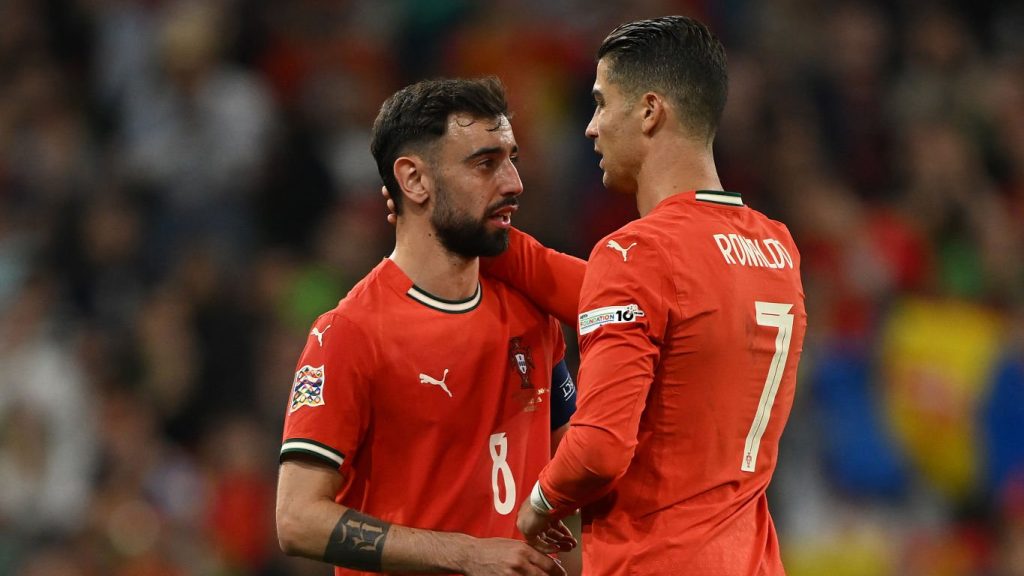
Nor does the succession offer a straightforward story of Fernandes taking Ronaldo’s place. Bernardo Silva moved to the top of Portugal’s captaincy hierarchy after the retirement, with Fernandes remaining among the senior leaders.
Fernandes was also among the captains involved in the meeting that agreed Portugal’s tribute to Ronaldo before the Denmark match. That does not expose every private thought he has about his former team-mate, but it is another observable act of recognition that belongs in the account.
A fair assessment cannot collect every ambiguous gesture as evidence of hostility while discarding every explicit expression of respect as meaningless.
The limits of the loyalty test
Ronaldo’s importance to Portuguese football does not need embellishment. The strength of supporters’ attachment to him is understandable. For many, his career forms part of how they came to follow the sport, and a debate about his place in a team carries an emotional weight that a routine selection argument does not.
That attachment can coexist with scrutiny of his performances, his decisions and the way a team operates around him.
The difficulty begins when defending a great player requires finding someone else responsible for every disappointment. A missed chance becomes inadequate service. A different passing choice becomes deliberate exclusion. A successful match without him becomes an insult. A team-mate’s insistence on collective responsibility becomes evidence that the dressing room has turned.
Once that interpretation takes hold, it can accommodate almost any outcome. It also becomes difficult to disprove, because the public evidence contradicting it is dismissed as diplomacy.

There is no need to replace that story with another fiction in which Fernandes and Ronaldo must be inseparable friends. Professional respect does not require permanent agreement. Two players can admire one another, frustrate one another and want different things from the same match.
What the available evidence supports is narrower and more useful: Fernandes has repeatedly defended Ronaldo’s contribution; Ronaldo publicly rejected the suggestion of a rift in the episode most often used to illustrate one; other Portugal players have faced similar accusations of disloyalty without those accusations establishing a conspiracy.
Fernandes’s football and captaincy remain open to criticism. The claim that he hates Ronaldo, or that he should be treated as the hidden cause of dressing-room upheaval, asks the evidence to carry far more than it can.
Respecting Ronaldo should not require inventing enemies for him.
You have just read “Does Bruno Fernandes Really Hate Cristiano Ronaldo?” Follow 52Hz Football for more stories about football, its rules and its culture.
