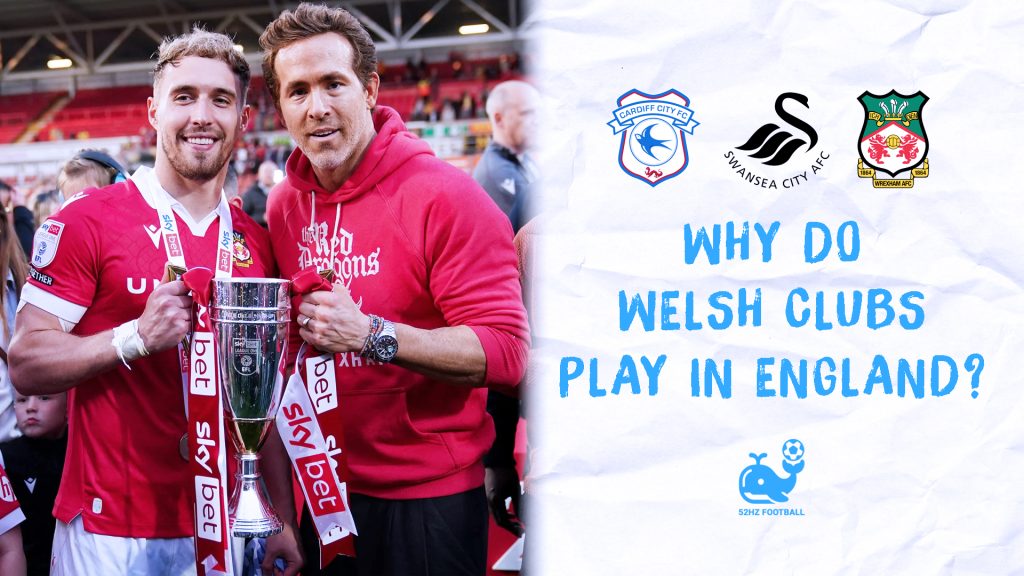
Discover the history of Welsh clubs playing in England. Uncover why Cardiff City, Wrexham and Swansea left home, the “Irate Eight”, and other cross-border football anomalies.
The English Premier League and its associated divisions are renowned as the most attractive and fiercely competitive football competitions on the planet. However, many fans wonder why Welsh clubs play in England directly against English giants rather than competing in their own domestic league.
The prominent presence of Cardiff City, Swansea City, and the Hollywood-owned Wrexham in English football is not a geographical accident, but rather the result of a fascinating historical evolution spanning over a century.
This comprehensive article on 52Hz Football will uncover the core reasons behind this phenomenon, detail the specific Welsh clubs playing in England today, and explore the bizarre reverse scenarios.
1. Historical Context
To truly understand this cross-border phenomenon, we have to look back at the late 19th and early 20th centuries. The primary reason for the initial migration was surprisingly simple: At the time these historic clubs were founded, Wales simply did not have a national football league.
The Lack of a Professional Domestic Foundation
Although football was introduced to Wales quite early, the sport was massively overshadowed by the immense popularity of rugby. Wales did possess a knockout tournament in the form of the Welsh Cup (founded in 1877), but they lacked the infrastructure to organize a nationwide professional league format until the late 20th century.
Highly ambitious and well-supported clubs like Wrexham (1864), Cardiff City (1899), and Swansea City (1912) found themselves at a crossroads. To grow their fanbases, secure stable revenue, and play competitive matches on a weekly basis, they chose to join the neighboring English football system, which already boasted a thriving, fully professional pyramid.
The Political Crisis: FIFA, the IFAB Seat, and the Birth of the Cymru Premier
For decades, this cross-border arrangement worked smoothly. However, in the late 1980s and early 1990s, the Football Association of Wales (FAW) faced mounting pressure from UEFA regarding the absence of a national league.
Critics increasingly questioned how Wales could maintain full international status – including its historic permanent seat on the International Football Association Board (IFAB), the body that determines the Laws of the Game – without possessing a domestic league structure.
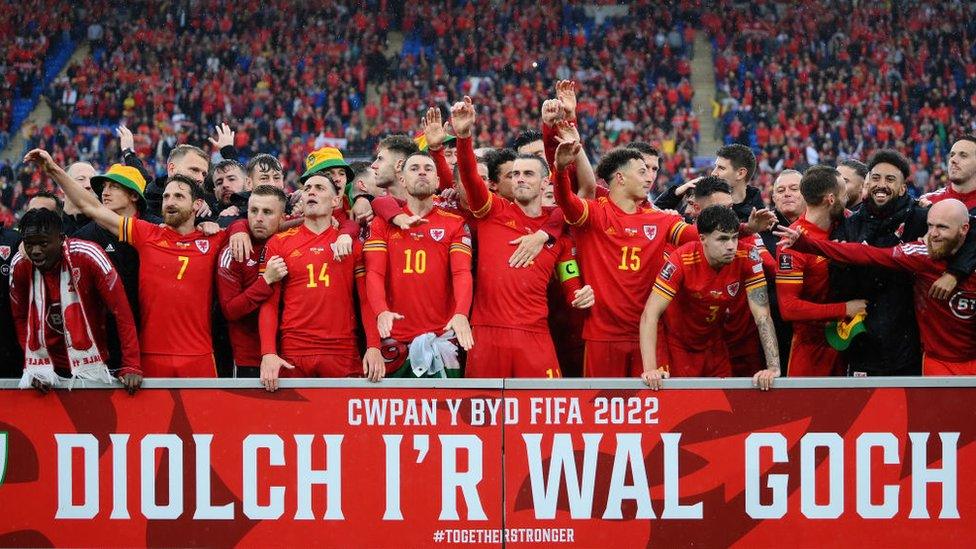
Wales qualified for Euro 2016, 2020 & 2022 World Cup largely thanks to the contributions of Gareth Bale.
Faced with the risk of diminished standing within international football governance, the FAW moved to establish a national competition.
In 1992, they created the League of Wales (now known as the Cymru Premier) to formalize their domestic pyramid and reinforce their institutional legitimacy within UEFA and FIFA structures.
To support the new league, the FAW required Welsh clubs playing outside the English Football League to return to the domestic system or seek special permission to remain within the English structure.
The “Irate Eight” Rebellion
The three professional clubs – Cardiff City, Swansea City, and Wrexham – were not affected by this directive because they were already long-standing members of the English Football League system.
However, several Welsh non-league clubs playing in England resisted the FAW’s request to join the new League of Wales. The British media dubbed this group the “Irate Eight”.
This group consisted of Bangor City, Barry Town, Caernarfon Town, Colwyn Bay, Merthyr Tydfil, Newport County, Newtown and Rhyl.

Newport County is a notable Welsh clubs playing in England.
Their resistance was driven largely by financial and competitive concerns. The newly formed League of Wales was semi-professional and offered significantly lower revenues, smaller crowds, and reduced competitive opportunities compared to the English non-league pyramid.
The fates of the “Irate Eight” eventually split into different paths:
- Despite initial resistance, Bangor City, Newtown, Rhyl, and Caernarfon Town joined the League of Wales in time for its inaugural 1992-93 season.
- Barry Town also entered the Welsh league system and later became one of its dominant clubs.
Colwyn Bay remained in the English pyramid for many years before eventually joining the Welsh system in 2019. - Only Newport County and Merthyr Town (successor to the liquidated Merthyr Tydfil) continue to play within the English football pyramid.
- Newport County recovered from financial collapse and currently competes in League Two (the 4th tier of English football).
- Merthyr Town, formed in 2010 after Merthyr Tydfil’s liquidation, plays in the English non-league system and has chosen to remain outside the Welsh domestic pyramid.
2. Which Welsh teams play in the Premier League / English Football League?
Today, 5 Welsh clubs remain official members of the English football system. Over the decades, they have carved out unforgettable moments in British football history.
Cardiff City
Cardiff City is statistically one of the most successful Welsh teams to play in England. Their crowning achievement came in 1927 when they defeated Arsenal in the FA Cup final. To this day, Cardiff remains the only non-English team to ever lift the oldest domestic cup competition in the world. In the modern era, they have also achieved promotion to the lucrative Premier League on two separate occasions (2013/14 and 2018/19).

Cardiff City competed in the English Premier League during the 2013-14 and 2018-19 seasons.
Swansea City
Swansea City became the first Welsh club to experience Premier League football since its rebranding in 1992. After securing promotion in the 2011/12 season, they managed to survive in this ruthless division for seven consecutive years, entertaining fans with their beautiful passing football.
Their absolute peak arrived in 2013 when they demolished Bradford City 5-0 in the League Cup final. This massive victory created a highly fascinating historical milestone: Swansea City Europa League qualification was achieved through the English system, but they officially competed in the tournament representing the Football Association of Wales (FAW).
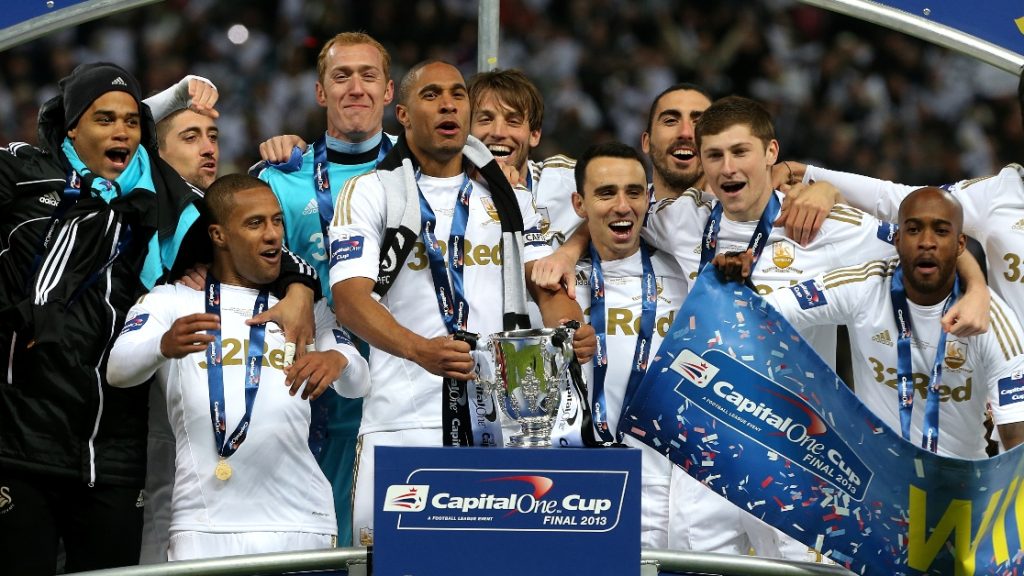
Swansea City won the 2012-13 League Cup, driven by the brilliance of Michu.
Wrexham AFC
Wrexham AFC (est. 1864) is the oldest club in Wales.
After suffering for years in the harsh environment of the English non-league system, Wrexham suddenly became a global phenomenon. The club was purchased by the Hollywood superstar who played “Deadpool” – Ryan Reynolds – and his friend Rob McElhenney.
Thanks to an injection of cash and a brilliant global media strategy driven by the hit documentary series “Welcome to Wrexham”, the club secured back-to-back promotions, generating massive excitement worldwide.

Ryan Reynolds’ Wrexham AFC has been performing impressively, rapidly climbing the English football pyramid
Newport County
Living up to their nickname, Newport County’s history is a rollercoaster of financial ruin and emotional triumphs. They tragically went bankrupt in 1989. In the early 1990s, they engaged in a complex jurisdictional dispute with the FAW.
The Welsh association wanted them to join the newly formed Cymru Premier, but Newport voluntarily chose to remain in the English Football League pyramid. As a result of this legal standoff, they had to temporarily play their home games across the border in Moreton-in-Marsh, England.
Following their reformation, Newport County patiently climbed back up from the absolute bottom of the amateur tiers to successfully rejoin the professional ranks in 2013.
Merthyr Town
Operating on a much smaller scale than the other four clubs, Merthyr Town currently competes in the National League North (tier 6 of the English pyramid).
Despite their modest budget and lower-league status, the club and its passionate supporters fiercely defend their membership in the English system and consistently refuse any suggestions of joining the Welsh domestic league.
3. The Reverse Scenario: English Clubs Playing in Other Nations
While the presence of Welsh clubs in England is dictated by history and money, the British football map also features some brilliant geographical paradoxes. There are clubs located strictly within English borders that actively choose to compete in the Scottish or Welsh leagues.
Berwick Rangers
This is the most famous and unique anomaly in British football. The town of Berwick-upon-Tweed is located entirely in England, just a few miles south of the Scottish border. Despite this, the town’s representative club, Berwick Rangers, has competed in the Scottish football league system since 1905.
The primary reason was geography and travel costs. Traveling north into Scotland to play away matches was significantly closer and cheaper than embarking on grueling trips down to the south of England.
Berwick Rangers famously sent shockwaves through the sport in 1967 when they defeated the mighty Rangers FC 1-0 in the Scottish Cup. Following their lead, another local amateur side, Tweedmouth Rangers, also competes in the Scottish football pyramid.
The New Saints (TNS)
The New Saints (commonly known as TNS) are the undisputed kings of the Welsh Cymru Premier, having dominated the league for years. However, their origins are incredibly complex.
TNS is actually the product of a merger between two distinct clubs: Llansantffraid FC (from Wales) and Oswestry Town (an English club). Businessman Mike Harris merged the two sides to create a dominant footballing force.
Today, TNS plays all of its home matches at Park Hall, a stadium physically located in Oswestry, England. Yet, they remain the most successful team in the Welsh league and regularly represent Wales in UEFA Champions League qualification rounds.
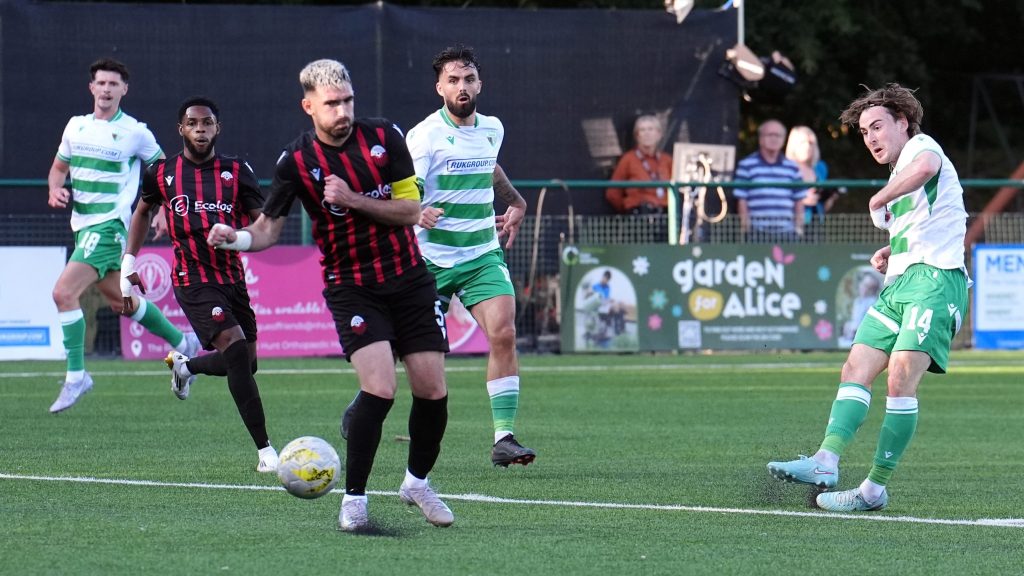
TNS (green & white) have frequently participated in UEFA Champions League and Europa League qualification rounds
APEA Akrotiri
The most obscure and fascinating geographical anomaly involves a club located on the Mediterranean island of Cyprus. APEA Akrotiri is a professional football club based in the region of Akrotiri. While physically located on the island of Cyprus, Akrotiri is officially a Sovereign Base Area – a recognized British Overseas Territory. Legally speaking, the club’s headquarters and home stadium are situated on “British soil”.
However, due to the extreme geographical distance from the United Kingdom, it is logically impossible for APEA Akrotiri to compete in the English football pyramid. Instead, they are officially affiliated with the Cyprus Football Association and currently compete in the Cypriot Second Division.
English clubs in Wales
Besides, due to geographical convenience, several amateur teams from the English county of Shropshire, located near the border, have chosen to compete in the lower tiers of Welsh football. Notable examples include Newcastle (Shropshire), Trefonen, Bishop’s Castle Town, Morda United, Llanymynech, Clun Valley (defunct 1996), Bucknell (defunct 2015), Chirk Town (defunct 2022).
4. Conclusion
The bizarre integration of Welsh clubs playing in England, along with geographical anomalies like Berwick Rangers, perfectly illustrates the organic and chaotic evolution of the beautiful game.
Historical decisions made for financial survival, coupled with geographical borders that have been entirely blurred by a shared passion for the sport, have created a uniquely diverse landscape in British football that cannot be replicated anywhere else in the world.
You have just read the article “Uncovering the Truth: Why Do Welsh Clubs Play in England?”. Follow 52Hz Football for more captivating stories about football, geography and culture.
READ MORE:
- Why Are So Many Football Clubs Called “Dynamo” or “Dinamo”?
- Gyokeres & 5 Players You Probably Forgot Played for Brighton
- 5 Best Individual Seasons in Premier League History
- 10 Best Premier League Signings Made After Turning 30
