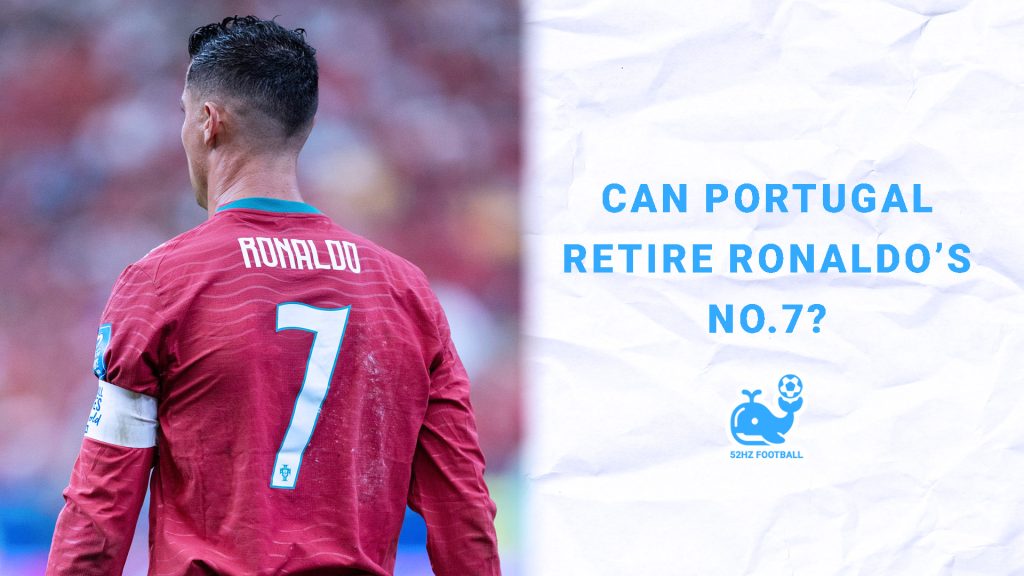
Portugal have added a horizontal line through the No.7 on their shirts to honour Cristiano Ronaldo.
The familiar number will remain available to future players, while the version without the line is being preserved as a tribute to their former captain.
But could Portugal retire Ronaldo’s No.7 altogether?
That would be harder to arrange. Major international competitions restrict the numbers teams can use, leaving little room to set one aside permanently. Portugal’s redesign allows the shirt to pass to another player while keeping a reminder of the man who made it famous.
1. Why Portugal Added a Line to No.7
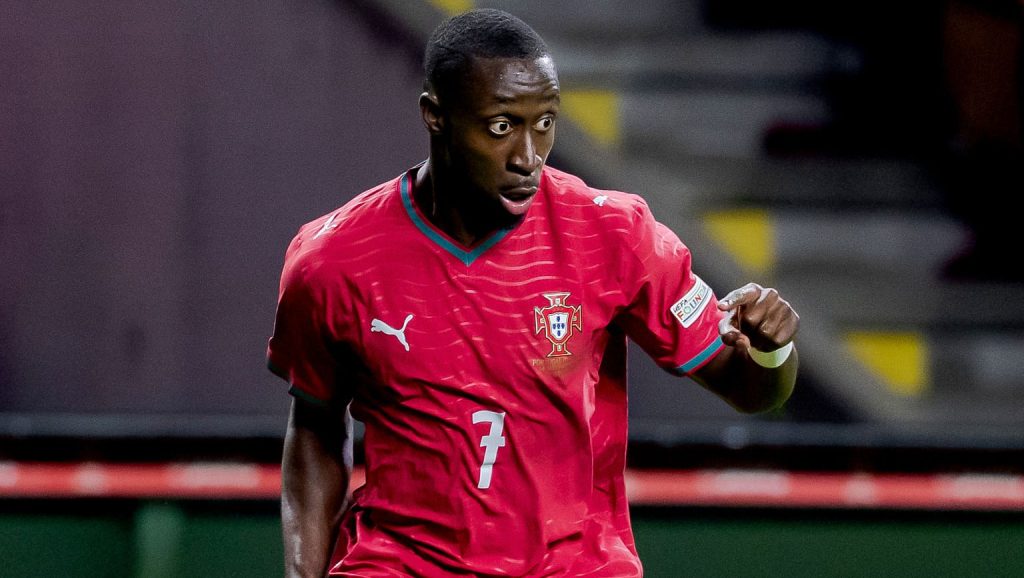
Carlos Forbs was allocated Portugal’s No.7 for the Nations League match against Denmark in Braga on 14 November 2026. The Club Brugge winger was listed with the number in Portugal’s squad for the match, their first since Ronaldo’s international retirement.
His shirt carried a small but deliberate change: a horizontal stroke through the middle of the seven. The Portuguese Football Federation introduced the new design to honour Ronaldo, reserving the previous version for the memories and achievements associated with his career.
Forbs had worn seven for Portugal before. He made his senior international debut in the number during the 9–1 win over Armenia on 16 November 2025, when Ronaldo was suspended.
Receiving it again against Denmark made Forbs the first player to wear the redesigned number. It did not establish him as its permanent owner. Portugal have kept seven in circulation, with a new appearance for the players who follow Ronaldo.
2. Why Retiring a Number Is Harder for National Teams
National teams cannot choose their shirt numbers as freely as supporters might imagine. Each competition sets its own permitted range.
In the 2026/27 Nations League, players must wear numbers 1–23 during the league phase, quarter-finals and play-offs. The range expands to 1–26 for the finals.
The 2026 World Cup numbering rules also allocate numbers 1–26 to each team.
| Competition or stage | Permitted numbers |
|---|---|
| Nations League 2026/27: league phase, quarter-finals and play-offs | 1–23 |
| Nations League 2026/27: finals | 1–26 |
| FIFA World Cup 2026 | 1–26 |
The difficulty becomes clear with a full squad. Nations League teams submit a 23-player match sheet, rising to 26 at the finals. Leaving No.7 unavailable would leave one fewer number than the number of players on that list.
Giving its replacement No.77 would not solve the problem, because that number falls outside the permitted range. Retiring seven while keeping every squad place would therefore mean departing from the competition’s normal numbering rules.
The exact restrictions depend on the tournament and stage. There is no single 1–23 rule covering every international fixture, but the limited ranges used at major competitions make a permanent retirement difficult.

3. How Club Shirt Retirements Differ
Retired shirts are a familiar part of club football. West Ham United officially retired Bobby Moore’s No.6 in August 2008, honouring the captain who had become inseparable from the number.
Such decisions still depend on the rules of the competition. A club can only set a number aside within the numbering system available to it, just as a national federation must follow the regulations of the tournaments it enters.
For Portugal, changing the design offers a way to honour Ronaldo while keeping all the required numbers available. The tribute can remain on the shirt without creating a gap in the squad list.
READ MORE:
Ronaldo’s Hat-Trick at 41: Who Else Has Scored Three After 40?
4. How Portugal Honoured Ronaldo in Braga
The redesigned seven was part of a wider tribute before the Denmark match. Portugal’s players lined up in No.7 shirts before kick-off, while supporters displayed a banner thanking their former captain.
Those matching shirts were worn for the ceremony. The players then used their individual match numbers, with seven allocated to Forbs.
It was a fitting image for a player whose shirt number had become part of his name. Yet Ronaldo’s own Portugal career began in another number, years before seven became his lasting signature.
5. Which Other Numbers Did Ronaldo Wear for Portugal?
Before becoming synonymous with Portugal’s No.7 shirt, Cristiano Ronaldo wore No.16, No.11 and No.17 for the senior national team. He also wore different numbers while progressing through Portugal’s youth and Olympic sides.
| Number | Portugal team | When he wore it |
|---|---|---|
| 16 | Senior national team | His debut against Kazakhstan on 20 August 2003 |
| 11 | Senior national team | His first international start, against Albania on 11 October 2003 |
| 17 | Senior national team | EURO 2004 and the 2006 World Cup |
| 11 | Under-21s | His early Under-21 appearances |
| 7 | Under-17s | The 2001/02 period |
| 7 | Olympic team | Athens 2004 |
| 7 | Senior national team | EURO 2008 and his subsequent senior international career |
5.1. No.16: Ronaldo’s Senior Portugal Debut
Ronaldo made his senior Portugal debut wearing No.16 against Kazakhstan in Chaves on 20 August 2003. He was 18 and had made his Manchester United debut just four days earlier.
He replaced Rui Costa at half-time as Portugal won the friendly 1–0. Figo was also in the team and held the No.7 shirt.
5.2. No.17: Ronaldo’s Early Major Tournaments
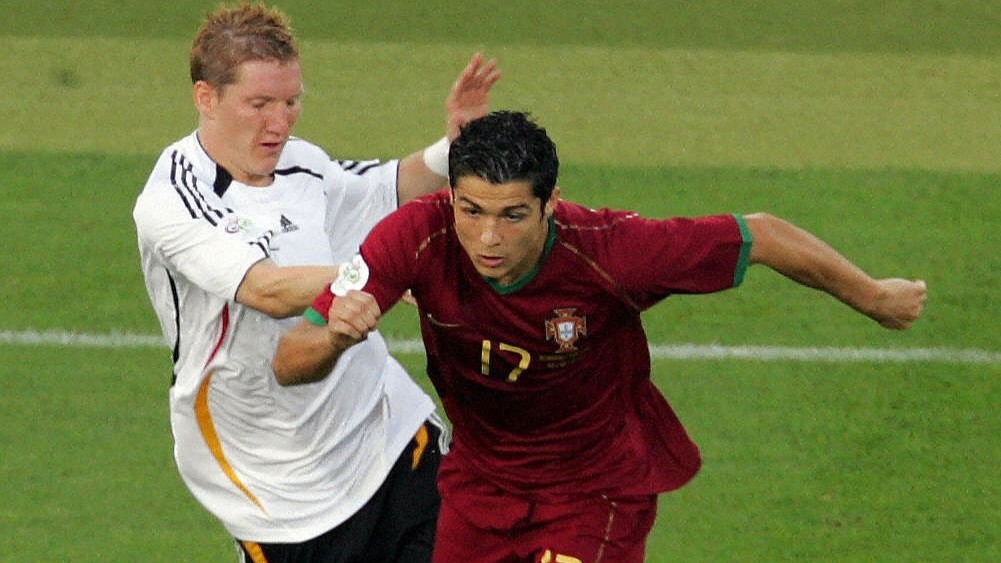
No.17 became the familiar number of Ronaldo’s early senior international career. He wore it at EURO 2004 on home soil and again at the 2006 World Cup, while Figo wore seven.
Seventeen appears in some of the defining images of the young Ronaldo: the tears after Portugal’s defeat in the 2004 European Championship final, followed by the run to the World Cup semi-finals two years later.
By EURO 2008, Ronaldo had inherited No.7 and Ricardo Quaresma was wearing No.17. Figo’s international career had ended after the 2006 World Cup, leaving the shirt to a new generation.
5.3. No.11: Under-21 and Senior Appearances
Ronaldo wore No.11 for Portugal’s Under-21 team and also used it in the senior side.
On 11 October 2003, he wore eleven for his first senior international start against Albania. Portugal won 5–3, with Ronaldo playing the first half.
It was another brief chapter before seventeen became his regular number at major tournaments.
5.4. No.7 at the Athens Olympics
Ronaldo had already worn seven for Portugal’s Under-17s during the 2001/02 period, before his senior international debut.
He then wore No.7 at the Athens 2004 Olympics, shortly after appearing in No.17 at that summer’s European Championship. Danny wore seventeen in the Olympic squad.
The two tournaments had separate squad lists. Ronaldo could therefore be Portugal’s No.17 at the Euros and their No.7 at the Olympics just a few weeks later.
READ MORE:
Can a Footballer Refuse an International Call-Up? Cristiano Ronaldo’s Portugal Exit Explained
6. Who Takes Over Portugal’s No.7?
Forbs was the first holder of No.7 after Ronaldo’s international retirement, although he began the Denmark match on the bench.
That does not settle who will wear it in the years ahead. Selections, injuries and tournament squads can all change the allocation, and receiving the shirt for one fixture does not make it a permanent appointment.
The new design gives future wearers a visible connection to Ronaldo’s legacy while allowing them to build their own place in the team.
Ronaldo himself inherited a number already made famous by Figo. The next player to make seven his own will continue that history.

Ronaldo began his senior Portugal career wearing sixteen, briefly wore eleven and became a familiar figure in seventeen. Over time, seven became inseparable from his name.
The No.7 shirt remains available. Its new design acknowledges Ronaldo’s place in Portugal’s history while leaving the next wearer room to add something of his own.
You have just read “Can Portugal Retire Ronaldo’s No.7?” Follow 52Hz Football for more stories about football, its rules and its culture.
