In the landscape of modern European football, money usually dictates success. The rich get richer, and the small clubs are mere stepping stones. But far above the Arctic Circle, in a town where the sun doesn’t set in summer and doesn’t rise in winter, a footballing anomaly exists.
FK Bodo/Glimt (FK Bodø/Glimt) doesn’t have oil money, but they have a system that has brought Jose Mourinho, Pep Guardiola, and Simone Inzaghi to their knees.
Following their historic 3-1 victory over Inter Milan in the Champions League knockout stages, here are the Top 10 Facts you need to know about this club.
1. The Mystery of the Slash (/)
The first thing global fans notice is the punctuation. Why not Bodo Glimt or Bodo-Glimt? The answer lies in a historical compromise that dates back to the club’s origins.
Founded in 1916, the team was originally known simply as “Glimt,” which translates to “Flash” or “Gleam” in Norwegian, representing the speed and energy of the team.
However, as the club climbed the divisions, they hit a bureaucratic wall in 1948. The Norwegian Football Federation (NFF) flagged a conflict: another older club in the Trondelag region had already registered the name “Glimt”. To be allowed to compete, the northern club needed to distinguish itself geographically without losing its original identity.
The solution was to append the town’s name, but with a unique twist. Instead of using a standard hyphen or space, they chose a slash (/) to denote “Glimt of Bodo”.
This punctuation choice has survived for decades, making it one of the few club names in the world to feature such a character, effectively turning a bureaucratic necessity into a unique global brand identity.
2. Geography: Football in the Freezer
Bodo/Glimt is not merely a northern club; they are geographically extreme. Situated at a staggering 67° North, the city lies entirely within the Arctic Circle, creating an environment that defies the norms of European football.
During the summer months, the ‘Midnight Sun’ phenomenon means the sun never truly sets. This often disorients visiting teams, who find themselves kicking off at 8:00 PM in blinding daylight, struggling to adjust their internal circadian rhythms. Conversely, the winter brings the crushing darkness of the ‘Polar Night’, where the sun barely rises at all.
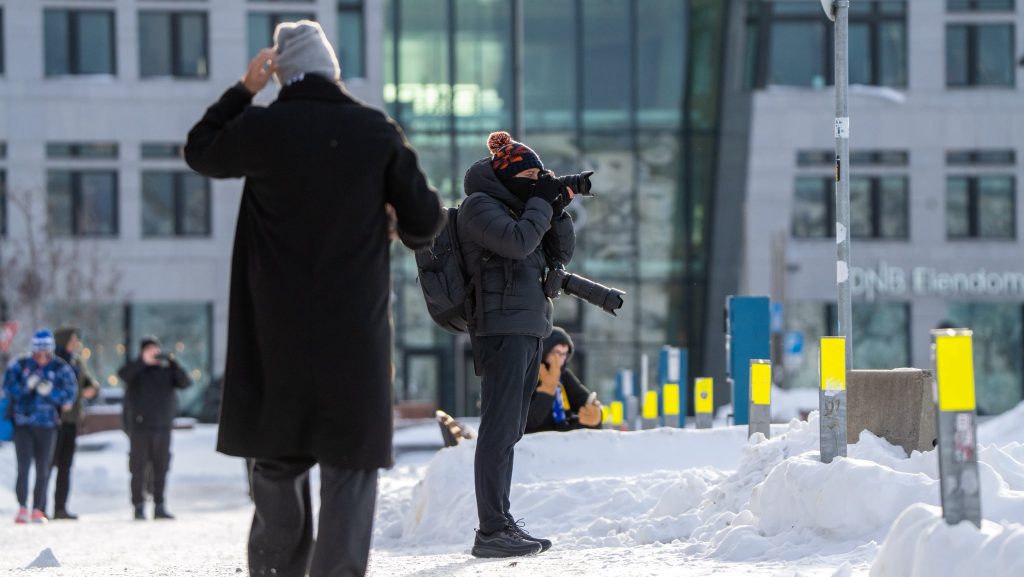
This extreme geography was historically used to segregate the club. For decades, the region was known as the ‘Banned North‘ because the Norwegian Football Federation excluded all Northern teams from the top flight, citing excessive travel costs and a lack of quality. This exclusion policy was finally lifted in 1971, allowing northern clubs to compete on a national level for the first time.
Just four years later, in 1975, Bodo/Glimt validated this decision by storming to a historic Norwegian Cup victory, shattering the old prejudices and proving once and for all that elite football belonged in the Arctic.
3. Home Ground: Aspmyra Stadion
The home ground, Aspmyra, holds only about 8,200 spectators, yet it stands as one of the most hostile environments in Europe for visiting elites.
Due to the harsh Arctic climate where natural grass cannot survive the winter, the club utilizes high-tech artificial turf. This surface is deliberately watered heavily before kick-off, making the ball zip across the ground at speeds 20-30% faster than usual. This rapid pace frequently disrupts the rhythm of possession-based giants like Roma or Man City.
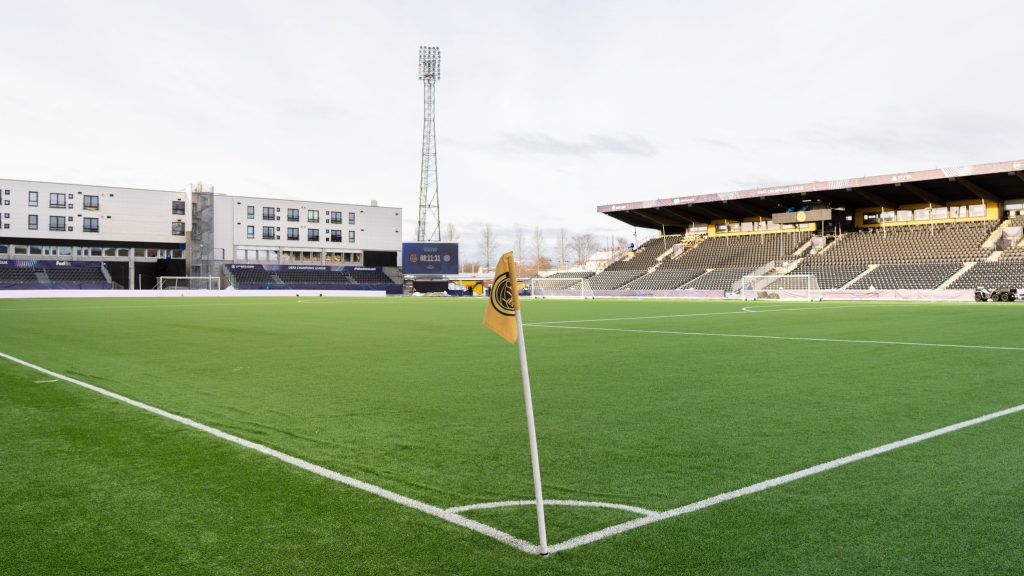
Compounding the challenge is the stadium’s open-ended design, which allows freezing winds from the Norwegian Sea to swirl directly onto the pitch, creating a freezing trap for unacclimatized opponents.
Looking to the future, the club is already outgrowing the tiny Aspmyra. The ambitious ‘Nye Bodo Stadion’ project is set to be a game-changer, which aims to utilize circular energy and innovative architecture to shield players from the brutal Arctic winds. With an expanded capacity meeting strict UEFA Category 4 standards, this new fortress will ensure that Bodo/Glimt remains a permanent fixture in the Champions League, rather than just a fleeting fairytale.
4. Fan Culture: The Yellow Toothbrush
While other clubs wave flags or scarves, the “Den Gule Horde” (The Yellow Horde) waves… giant yellow toothbrushes.
The tradition dates back to the 1970s. During an away game, a fan leader (a “capo”) wanted to conduct the singing but realized he had forgotten his baton. He reached into his pocket, pulled out his personal toothbrush, and used it to direct the chants. The team won, the toothbrush became a lucky charm, and a bizarre tradition was born.
5. The Berg Family
Few clubs in the world have a history so intertwined with a single family. The Berg family is to Bodo/Glimt what the Maldini family is to AC Milan.
-
Generation 1: Harald “Dutte” Berg (Club legend of the 60s/70s).
-
Generation 2: Ørjan Berg and Runar Berg (Midfield maestros of the 90s).
-
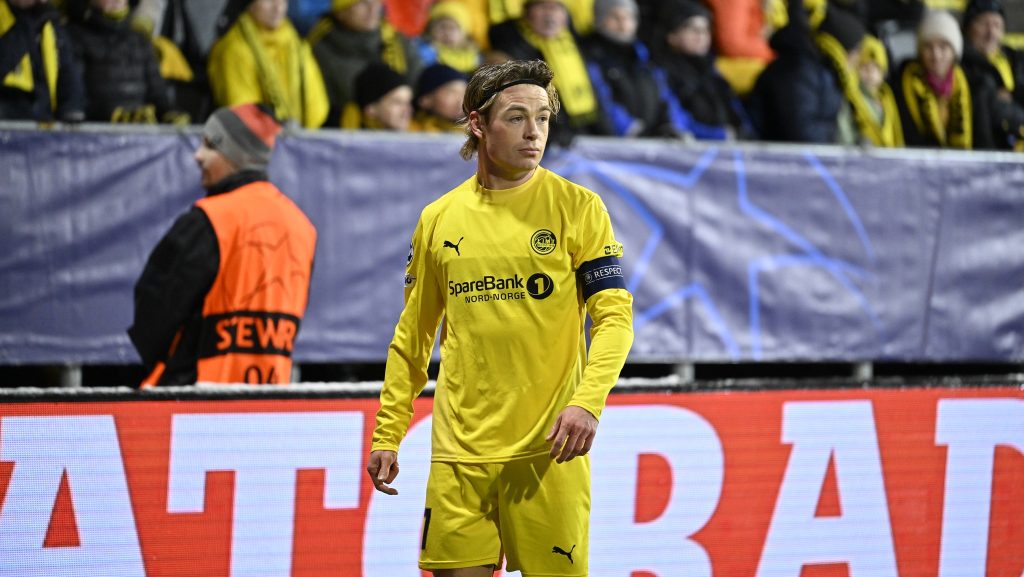
Generation 3: Patrick Berg. The current captain and heartbeat of the team. After a brief stint at RC Lens, he returned to the Arctic to lead the club to new heights. This dynasty ensures that no matter how many foreign players arrive, the “Local DNA” remains intact.
6. The “Rehabilitation Center” Model
Bodo/Glimt operates on a “Moneyball” strategy, but with a twist. They don’t just find undervalued stats; they find undervalued people. They specialize in two types of players: Rejects and Broken Toys.
-
Erik Botheim: Released by Rosenborg for not being good enough. Glimt fixed him, he destroyed Roma, and then left the club for millions.
-
Victor Boniface: Suffered two ACL injuries early in his career. Glimt nurtured him back to health, eventually selling him on a path that led to Bayer Leverkusen stardom.
-
Philip Zinckernagel: Arrived on a free transfer, broke league records, and moved to Watford (England).
7. The Fighter Pilot Mental Coach
Arguably, the most crucial signing in the club’s history wasn’t a prolific striker, but Bjørn Mannsverk, a former Fighter Pilot in the Royal Norwegian Air Force.
Serving as the club’s mental coach, Mannsverk identified a critical parallel between high-stakes aviation and elite football: both pilots and players suffer from debilitating anxiety about outcomes. His philosophy is deceptively simple: focus entirely on performance and ignore the result.
He teaches that in an aerial dogfight, the fear of death causes a pilot to freeze; similarly, in football, the fear of losing causes a player to hesitate.
To combat this, Glimt players practice meditation before training and play with the exact same intensity whether they are winning 5-0 or losing 0-1. This instilled stoicism is the primary reason they never panic when facing European giants.
8. The 6-1 Mourinho Massacre (2021)
The world first took notice on the freezing night of October 21, 2021. Jose Mourinho brought his AS Roma side to the Arctic Circle for a UEFA Europa Conference League group stage match, expecting a routine victory against a team of unknowns. Instead, they walked into a frozen nightmare.
The final 6-1 result sent shockwaves through the continent, marking the heaviest defeat in Jose Mourinho’s illustrious managerial career – the first time in over 1,000 games his team had ever conceded six goals.
-
8′ ⚽️ Botheim (1-0)
-
20′ ⚽️ Berg (2-0)
-
28′ ⚽️ Carles Pérez (2-1)
-
52′ ⚽️ Botheim (3-1)
-
71′ ⚽️ Solbakken (4-1)
-
78′ ⚽️ Pellegrino (5-1)
-
80′ ⚽️ Solbakken (6-1)
In the freezing post-match interview, a visibly shaken Mourinho offered no excuses for the result, famously admitting:
“I decided to play with this line-up, so the responsibility is mine.”
However, his most telling comment was a backhanded compliment that validated the Norwegians’ talent. The Portuguese manager conceded:
“We lost against a team that showed more quality on the night. It’s simple… Bodo/Glimt has more quality than us.”
That night, the “Special One” was left with no answers, wrapped tightly in his winter coat while watching a team with a budget smaller than his own salary tear his reputation apart.
9. “Kamikaze” Tactics
Head Coach Kjetil Knutsen refuses to compromise. His 4-3-3 system is often described as ‘Kamikaze’ football.
When small teams play big teams, they usually ‘park the bus’ (defend deep). Glimt does the opposite. They press high, send full-backs flying forward, and overload the box.
Against Man City in January 2026, they didn’t sit back; their relentless high press suffocated Man City’s build-up, forcing a turnover that led to Kasper Høgh’s clinical opening goal past Gianluigi Donnarumma.
It is high-risk, high-reward, and incredibly entertaining.
10. The 2026 Giant Killing: Atletico Madrid, Man City & Inter
If the Roma win was a fairy tale, the 2025/26 Champions League campaign is a gritty action movie. Bodo/Glimt has officially graduated from “cute underdog” to “European nightmare.”
- December 10, 2025: They signaled their intent by out-grinding the masters of defense, Atlético Madrid, in a 2-1 thriller that left Diego Simeone speechless in the freezing snow.
-
January 20, 2026: They defeated Pep Guardiola’s Manchester City 3-1 in the League Phase. Erling Haaland, returning to Norway, was silenced by the collective press of the Glimt defense.
-
February 18, 2026: In the Knockout Play-off first leg, they dismantled Inter Milan 3-1. The returning Jens Petter Hauge and Danish striker Kasper Høgh ran riot.
Beating the English Champions and the Italian giants in the space of 30 days proves one thing: The system works. The Artic Circle is no longer just a place to see the Northern Lights; it is where European giants go to die.
