
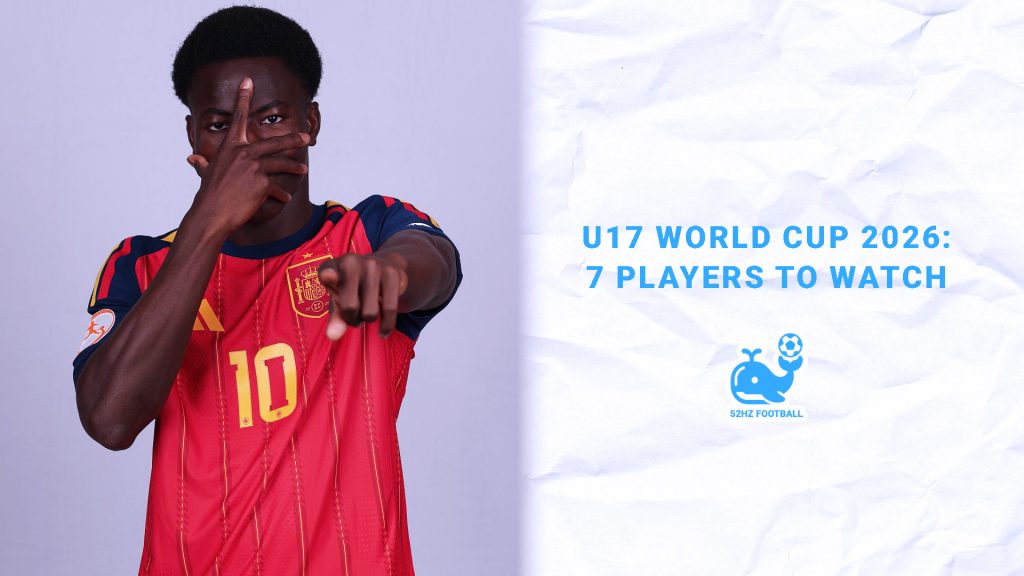
Ebrima Tunkara, Eduardo Conceição and Maki Kitahara are among our seven players to watch at the U17 World Cup 2026, alongside prospects from Argentina, Colombia, Italy and Tanzania.
Updated: 22 November 2026
The opening days of the U17 World Cup have already brought a reminder of how quickly a young player can attract attention. Ebrima Tunkara scored a free-kick in Spain’s opening victory, while Diego Perillo was on target as Italy began their campaign with six goals against Jamaica. Both arrived in Qatar with substantial achievements in European youth football behind them.
Elsewhere, continental competitions have supplied their own compelling candidates: a prolific Japanese midfielder, a Colombian forward who delivered against Brazil and Argentina, and a Tanzanian attacker competing several years ahead of his age.
These selections reflect performances in continental competitions, experience of senior football and the responsibility each player carries for his country.
Best U17 World Cup 2026 Players to Watch
| Player | Country | Club or development programme | Age |
|---|---|---|---|
| Ebrima Tunkara | Spain | Barcelona | 16 |
| Eduardo Conceição | Brazil | Palmeiras | 16 |
| Giovanni Baroni | Argentina | Talleres | 17 |
| Maki Kitahara | Japan | Fujieda MYFC, on loan from FC Tokyo | 17 |
| José Escorcia | Colombia | Atlético Nacional | 17 |
| Diego Perillo | Italy | Atalanta | 17 |
| Dismas Athanasi | Tanzania | TFF Talent Development Scheme | 14 |
Ages are measured at the start of the tournament on 19 November.
READ MORE:
1. Ebrima Tunkara, Spain
Tunkara arrived with one of the strongest individual credentials in the competition. The Barcelona midfielder was named Player of the Tournament at the 2026 U17 European Championship, registering four assists and 23 key passes as Spain reached the semi-finals. His influence extended across their attacking play: finding space to receive, changing the tempo and helping teammates combine around the penalty area.
He has already carried that threat into the World Cup. Against China on 20 November, Tunkara scored from a direct free-kick shortly before half-time and was involved in the move for Owen Mira’s first goal in Spain’s 5–0 victory. It was an opening performance that gave substance to the attention surrounding him.
🔚 ¡𝗙𝗜𝗡𝗔𝗟 𝗗𝗘𝗟 𝗣𝗔𝗥𝗧𝗜𝗗𝗢!
España brilla en su debut mundialista y suma los primeros tres puntos.
Crónica: https://t.co/ASoWPj4GrN
#U17WC | #NuestraBase https://t.co/0UbTsOXHYK
— Selección Española Masculina de Fútbol (@SEFutbol) November 20, 2026
The next point of interest is how opponents respond. His European performances give them plenty of reason to restrict his space. For viewers, his positioning before receiving the ball should be particularly revealing: the small adjustments that allow him to turn, draw a defender towards him or release a teammate.
He is a strong candidate to shape Spain’s tournament even in matches when somebody else supplies the goals.
2. Eduardo Conceição, Brazil
Palmeiras’ recent record of developing attacking talent ensures that Eduardo Conceição will attract attention. The academy that helped produce Endrick and Estêvão has another prospect whose close control and ability to take on defenders have earned him recognition ahead of the World Cup.
Conceição’s year began with a striking demonstration of his attacking range. In January, he scored four goals and supplied two assists in Palmeiras’ 9–0 Copinha victory over Batalhão. The following day, he signed his first professional contract, running until January 2029.
Those contributions help explain his appeal. He can finish attacks himself while also creating opportunities for others, giving Brazil several ways to use his ability around the penalty area.
View this post on Instagram
Qatar provides a broader test of that decision-making. International opponents will bring different defensive structures, and the available space will change from match to match. The most interesting passages may come when he has beaten his first opponent and must choose what follows.
For a young attacker with considerable technical freedom, that next action can determine how much his team gains from the initial moment of skill.
3. Giovanni Baroni, Argentina
Argentina’s No.10 shirt comes with considerable attention, and Giovanni Baroni has already encountered some of the expectations attached to professional football. The Talleres midfielder made his senior breakthrough under Carlos Tévez and arrives in Qatar with experience of the demands surrounding first-team football.
A creative left-footer, Baroni was an important contributor during South American qualifying. His two assists in Argentina’s 3–2 victory over Venezuela offered a useful illustration of his ability to influence a game through the players around him. He now occupies a central creative role in Diego Placente’s squad.
His club experience makes the transition back into international youth football particularly interesting. Players who have already faced senior opponents bring a different reference point for the speed of a challenge, the consequences of losing possession and the time available to make a pass.
View this post on Instagram
For Baroni, the opportunity is to combine that experience with the freedom to create. Argentina will need his imagination, especially against opponents willing to defend deep and crowd the central areas.
How effectively he finds teammates beyond that congestion could have a substantial bearing on their progress.
4. Maki Kitahara, Japan
Few midfielders arrived with a more persuasive scoring record from continental competition. Kitahara won both the Most Valuable Player and Top Goalscorer awards at the 2026 U17 Asian Cup, finishing with six goals as Japan lifted the trophy.
His final contribution was especially significant. Kitahara scored Japan’s third goal in their 3–2 victory over China, having already scored twice against Qatar and twice in the quarter-final win over Tajikistan. His influence continued through the decisive stages of the competition.
He also brings experience of senior club football. An FC Tokyo player spending time on loan at Fujieda MYFC, Kitahara has been developing in an environment where opponents are older and places must be earned against established professionals.
✨ 𝐀𝐅𝐂 𝐘𝐨𝐮𝐭𝐡 𝐏𝐥𝐚𝐲𝐞𝐫 𝐨𝐟 𝐭𝐡𝐞 𝐘𝐞𝐚𝐫 (𝐌𝐞𝐧) 𝐍𝐨𝐦𝐢𝐧𝐞𝐞𝐬 ✨
🇯🇵 Maki Kitahara
🇯🇵 Rion Ichihara
🇯🇵 Ryunosuke SatoReady to ignite their legacy with the world at their feet!
#AFCAwards2026 https://t.co/JlFMWaAlNQ
— AFC (@theafcdotcom) November 15, 2026
His scoring record makes the area around the penalty box an obvious place to watch him. The question for opponents is how closely they can track a midfielder who contributes to the build-up and can also become the player finishing the move.
That combination gives Japan a valuable source of attacking uncertainty.
5. José Escorcia, Colombia
Escorcia’s case rests on an unusually convincing sequence of important performances. During Colombia’s South American U17 title campaign, he scored twice against Brazil in the semi-final and added another goal in the 4–0 final victory over Argentina.
He finished the tournament with four goals and two assists, establishing himself as one of the central figures in Colombia’s success. The opposition and the circumstances give those numbers particular weight: three of his goals came in the last two matches, when the title was being decided.
José Escorcia made his professional debut for Atlético Nacional today vs Boyacá Chicó! The star player for the U17 Colombia National Team provided this assist on his professional debut! Top talent. 🇨🇴👏 https://t.co/TELTXCKKQ3
— Colombian Fútbol Report 🇨🇴 (@ColFootyReport) October 17, 2026
The Atlético Nacional attacker offers speed, agility and a willingness to attack defenders. He has identified Luis Díaz as an inspiration, with the senior Colombia international providing an obvious reference point for a young player developing in a similar attacking position.
Qatar will bring greater familiarity from opponents who have studied that successful continental campaign. Escorcia’s response should be worth following: how he finds space when defenders anticipate his movements, and how readily he combines with teammates when a direct route towards goal closes.
Colombia have already seen him deliver in major matches. The World Cup offers the opportunity to extend that record.
6. Diego Perillo, Italy
Perillo has already supplied some of the defining moments of Italy’s year. He scored the winner against France in their U17 European Championship opener and converted the decisive penalty in the final shootout against Belgium.
His contribution earned him a place in UEFA’s Team of the Tournament. Alongside his finishing, the technical observers highlighted his ability to combine with teammates around the penalty area and contribute to Italy’s collective attacking play.
The Atalanta forward has begun the World Cup productively, too. In Italy’s 6–0 opening victory over Jamaica, he headed in the third goal and was involved in the incident that produced the own goal for their fourth, before being replaced at half-time.
His development carries an interesting club dimension. Perillo moved from Empoli to Atalanta in July after winning the Italian U17 league title with his former club and the European Championship with his country.
For viewers, his movement inside the box is the obvious starting point. Italy’s opening match has already shown how quickly he can turn a delivery into a scoring opportunity.
Watch Italy v Jamaica on FIFA’s official video service.
7. Dismas Athanasi, Tanzania
At 14, Dismas Athanasi is one of the tournament’s most striking stories. He arrived in Qatar as the leading scorer from the 2026 U17 Africa Cup of Nations, where his three goals helped Tanzania reach their first final.
Two came in a dramatic 3–3 quarter-final draw against Algeria, before Tanzania advanced on penalties. They eventually finished runners-up to Senegal, securing a place at their first U17 World Cup along the way. Athanasi had made a decisive contribution while competing against players several years older.
His ability to operate across the attack gives Tanzania options. In matches where they spend long periods defending, a forward who can recognise space and provide an outlet becomes especially valuable. Athanasi’s continental performances suggest he can offer that support alongside his finishing.
The World Cup will test how consistently he can find those opportunities against unfamiliar opponents. His movement when Tanzania recover possession should be as interesting to follow as his efforts inside the penalty area.
His 15th birthday falls on 26 December, almost two weeks after the final. For now, he has an important part to play in Tanzania’s first appearance on this stage.
How Old Are Players at the U17 World Cup 2026?
The 2026 age window is 1 January 2009 to 31 December 2011. Players can be 17 during the tournament, but a 2008-born footballer is too old even if his 18th birthday has not yet arrived. Athanasi, who turns 15 in December, meets the lower age requirement for the calendar year.
How Do These Players Compare With the Most Valuable U17 Footballers?
Market value and tournament selection answer different questions. Our August 2026 ranking of the most valuable U17 footballers includes players who are absent from Qatar because of age, selection or qualification. Dowman, for example, cannot appear because England did not qualify for the U17 World Cup 2026.
READ MORE:
Explore more of our World Cup coverage.
You’ve just read the article “7 Players to Watch at U17 World Cup 2026”. Follow 52Hz Football for more captivating stories about football, geography and culture.
