
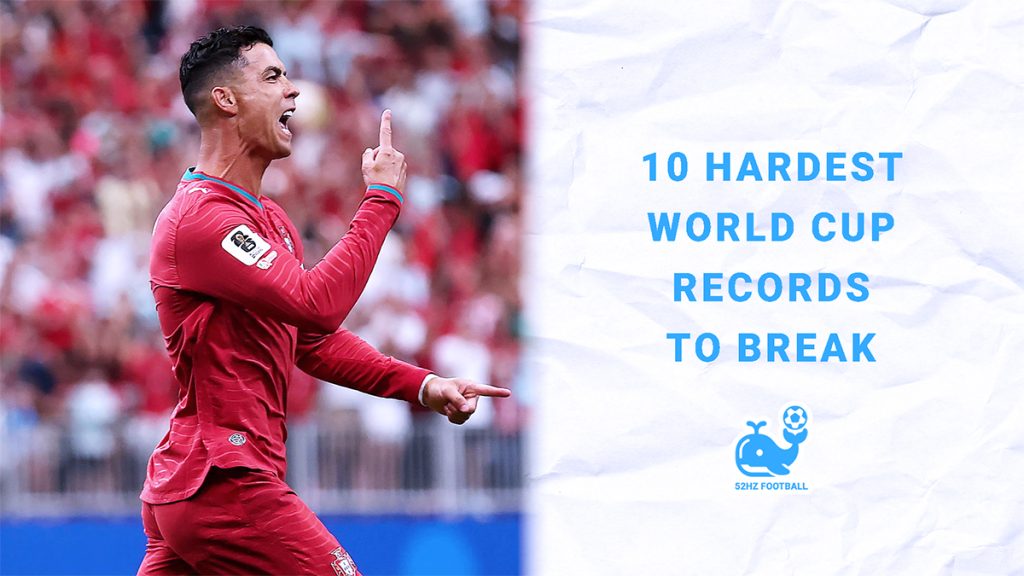
Some football records are meant to be broken, while others – like Cristiano Ronaldo scoring across six different World Cups or Fontaine’s 13-goal miracle – are etched in stone, defying logic and time itself
Since Lucien Laurent scored the first goal in a snowy Uruguay in 1930, the FIFA World Cup has been the ultimate theater of human drama. It is a place where legends are forged in gold and where tragedies are etched in tears.
Over nearly a century, we have witnessed statistics that defy logic. Some records are meant to be broken; they are merely placeholders waiting for the next generation to run faster or jump higher.
But others? Others seem to belong to a different universe entirely, protected by the shifting sands of history, tactical evolution, and the sheer improbability of lightning striking the same spot twice.
As we look toward the expanded 48-team tournament in 2026, we must ask ourselves: in an era of hyper-professionalism and tactical pragmatism, are these 10 milestones actually impossible to conquer?
Here are the 10 hardest World Cup records to ever be broken.
1. Cristiano Ronaldo – Scoring in 6 Different World Cups
The sheer longevity required to achieve this is almost beyond human comprehension. By scoring a phenomenal goal at the 2026 World Cup, Cristiano Ronaldo officially became the first and only player in the history of football to score in six different World Cup tournaments (2006, 2010, 2014, 2018, 2022, and 2026).
Why it’s untouchable? The math is terrifying. To score in six World Cups, a player must maintain peak, world-class physical condition for over 20 years. They must avoid career-ending injuries, continuously be selected by their national team over multiple generations of younger talent, and their nation must qualify for six consecutive tournaments.
Even Lionel Messi, who has played in six tournaments, failed to score in the 2010 edition, halting his streak at five. The four-year gap between World Cups means that even the greatest prodigies who start at 18 would need to still be dominating the globe at 38 to even have a chance of matching this.
Verdict: The absolute peak of physiological possibility. Untouchable.
2. Brazil – 5 World Cup Titles
When you look at the famous canary-yellow jersey, your eyes are immediately drawn to the crest. Above it sit five green stars, symbolizing the triumphs of 1958, 1962, 1970, 1994, and 2002.
To understand the magnitude of this record, you have to look at the chasers. Germany and Italy are stuck on four. Argentina, even with the divine intervention of Lionel Messi in 2022, sits on three.
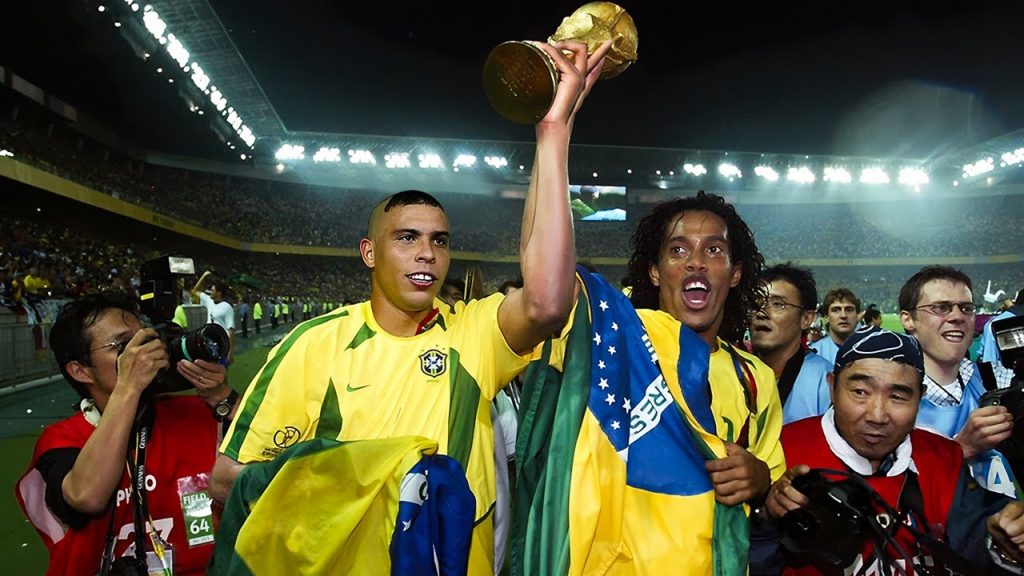
Why it’s untouchable? Winning one World Cup is the pinnacle of a sporting life. Winning five requires a nation to produce “Golden Generations” consistently over half a century.
Currently, the gap is widening. Italy has missed two consecutive World Cups (2018, 2022). Germany has failed to exit the group stage in the last two editions. Brazil, despite their own struggles since 2002, remains the benchmark.
For a nation to catch Brazil, they would need to dominate the sport for the next 12 to 16 years perfectly. Given the parity in modern football – where teams like Morocco and Croatia can reach the final four – the idea of one nation hoarding trophies like Brazil did in the Pele era seems mathematically improbable.
Verdict: Safe for at least another two decades.
3. Brazil – 100% Attendance Record
Brazil is the only nation to have qualified for and participated in every single World Cup finals since 1930. That is 23 tournaments in a row (including 2026).
This sounds simple – “just qualify” – but history tells us it is a minefield. Look at Italy (4-time champions) missing out recently, the Netherlands missing 2002 and 2018, England missing 1994. Even Argentina nearly missed out in 2018 until Messi saved them on the final day of qualifying.
To break this record, a nation would need to start a streak today and maintain it for the next 90 years. Furthermore, Brazil’s record is protected by geography. The CONMEBOL qualifying format is grueling, but Brazil is simply too big and too talented to fail. Even in their worst years, they finish in the top 4 of South America.
Unless FIFA bans them, the Seleção will always be there.
Verdict: Impossible to break. It can only be equaled, and that would take a century.
4. Pelé – Most Titles by a Single Player (3)
There are many dual-winners in history (Cafu, Ronaldo Nazario, Giuseppe Meazza). But only one man has three.
Edson Arantes do Nascimento, known to the world as Pelé, lifted the trophy in Sweden (1958), Chile (1962), and Mexico (1970).
Why it’s untouchable? Let’s look at the mathematics. To win three World Cups, a player needs a career that spans at least 12 years at the absolute peak. They need to be selected for three different squads. And, most importantly, their national team needs to win the tournament three times in that span.
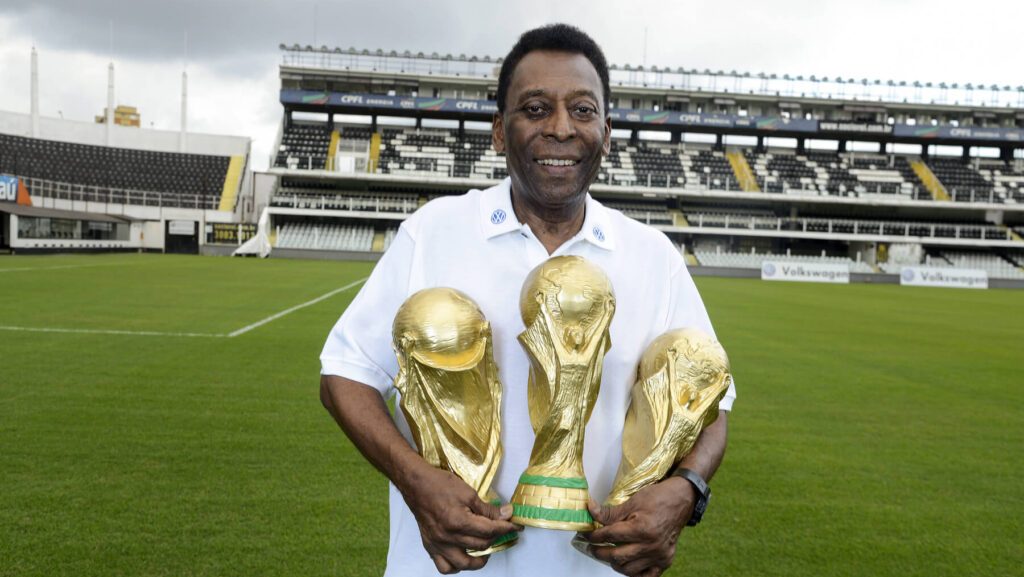
In the modern era, retaining the World Cup is almost impossible (no team has defended the title since Brazil in 1962). Look at Kylian Mbappé. He won it at 19 and reached the final again at 23. He is on the perfect trajectory. Yet, to match Pelé, he needs to win two more. One bad game, one penalty shootout, or one injury, and the dream dies.
Messi needed five attempts just to win one. Cristiano Ronaldo has played in six and never reached the final. Pelé’s record is a mixture of supreme talent and supreme destiny.
Verdict: Highly unlikely.
5. Pelé – Youngest Goalscorer (17 years, 239 days)
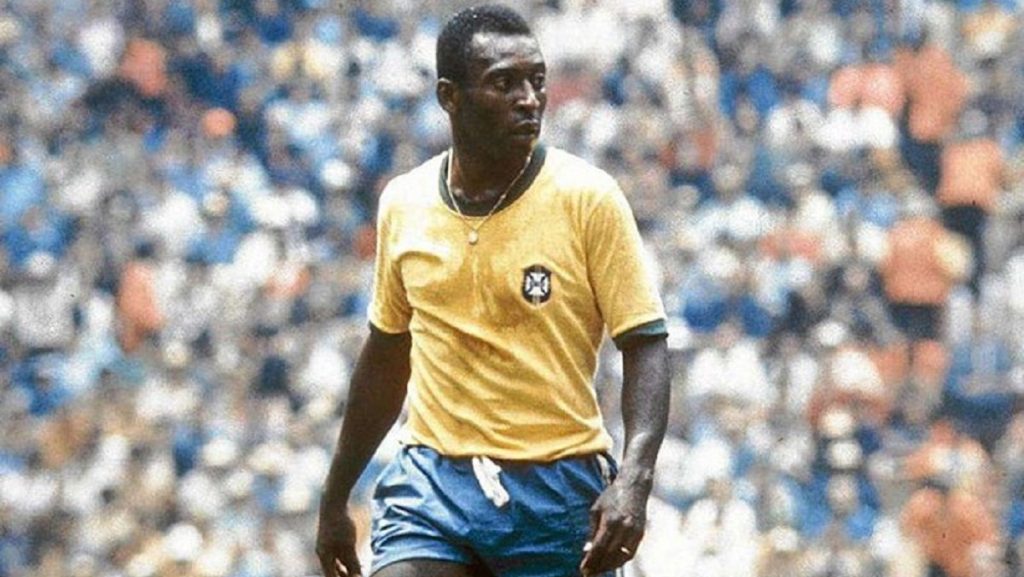
On June 19, 1958, a teenager chest-controlled a pass, flicked it over a Welsh defender, and volleyed it home. At 17 years and 239 days old, Pelé became the youngest scorer in World Cup history.
“Structure of Time” protects this record. In the modern game, academies protect players and managers are cautious. It is rare for a 17-year-old to even make a World Cup squad, let alone start and score in a knockout game.
We have seen close calls. Gavi (Spain) scored at 18 in Qatar. Lamine Yamal (Spain) broke records at the Euros, but due to the four-year World Cup cycle, he will be almost 19 by the time the 2026 World Cup kicks off. Endrick (Brazil) will also be approaching 20.
The window of opportunity is tiny. A player has to be a generational prodigy and turn 17 exactly when a World Cup is happening. If the tournament falls when they are 15 (too young) or 19 (too old), the record survives.
Verdict: Extremely difficult due to the 4-year cycle.
6. Juan José Tramutola – Youngest Coach (27 years, 267 days)
In 1930, Argentina was managed by Juan José Tramutola. He was 27 years old – younger than many of his players and led them to the final.
Currently, football has changed. In 1930, coaching was more about selection and fitness. Today, it is about data analysis, media management, and tactical periodization.
To get a UEFA Pro License or equivalent, a coach usually needs years of study and experience. Julian Nagelsmann was considered a “baby” coach when he took over Hoffenheim at 28, but managing a National Team at a World Cup requires political weight and gravitas.
Imagine the English FA or the Brazilian CBF hiring a 27-year-old today. The media would destroy them before the first training session. The youngest coach at the 2022 World Cup was Argentina’s Lionel Scaloni, and he was 44. The gap is enormous.
Verdict: Impossible.
7. Just Fontaine – Most Goals in a Single Tournament (13)
Thirteen goals. Read that again. Thirteen.
Most strikers dream of scoring 13 goals in their entire World Cup careers. Just Fontaine of France did it in six matches at the 1958 World Cup.
His run included a hat-trick against Paraguay, two against Northern Ireland, one against Scotland, one against Brazil, and four against West Germany in the third-place playoff.
And why it’s untouchable? Modern defenses are too organized. In 1958, the tactical systems were loose, often playing with five forwards. Today, teams defend with low blocks and intricate pressing traps. Some Golden Boot winners in recent years (Harry Kane, James Rodriguez, Ronaldo) usually score 6 goals.
To break this, a player would need to score a hat-trick in roughly four consecutive games. However, there is a slight possibility. The 2026 World Cup will have 48 teams. This means an extra knockout round and potentially weaker opposition in the group stages.
Could a Haaland or Mbappe score 5 goals against a minnow nation and build momentum? It’s the only record on this list that has a mathematical glimmer of hope.
Verdict: Very Unlikely, but the expanded format gives it a 1% chance.
8. Highest Attendance at a Single Match (173,850)
The 1950 World Cup deciding match between Brazil and Uruguay was held at the Maracanã. There were no seats, no safety barriers, just concrete terraces. The official attendance was 173,850, but estimates suggest nearly 200,000 people were crammed inside.
And which makes it untouchable? Safety regulations.
Following tragedies like Hillsborough and Heysel, FIFA mandated all-seater stadiums. The largest stadium used in Qatar 2022 (Lusail) held 88,000. The MetLife Stadium for the 2026 final holds roughly 82,000. Even the massive Rungrado 1st of May Stadium in North Korea (claimed 114,000 capacity) wouldn’t host a World Cup final.
Unless we revert to building Roman Colosseums the size of small cities, we will never see a crowd of this magnitude again.
Verdict: Physically impossible.
9. Roger Milla – Oldest Goalscorer (42 years, 39 days)
In 1994, Roger Milla was essentially retired, playing football for fun on the tropical island of Reunion. The President of Cameroon personally called him and begged him to play. Milla agreed, flew to the USA, and scored against Russia at the age of 42.
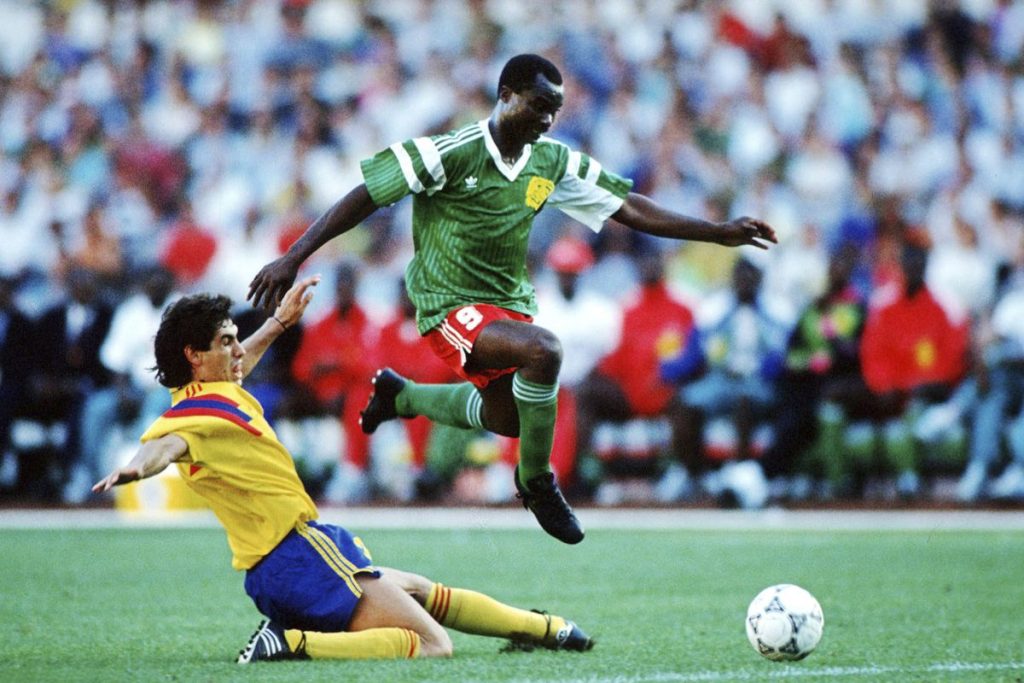
Now, Father Time is undefeated. The pace of the modern game is blistering. Pressing systems require forwards to run 10-11km per game. Therefore, a 42-year-old body simply cannot keep up with 20-year-old defenders.
Pepe (Portugal) scored a header at the 2022 World Cup at age 39. He was close, but still three years off. Even Cristiano Ronaldo, who just scored in the 2026 World Cup with superhuman fitness at age 41, is still younger than Milla.
In conclusion, to break this record, a player needs to be playing and scoring against the world’s elite at 43.
Verdict: Very difficult, even for super-athletes.
10. Brazil 1-7 Germany – Biggest Semi-Final Margin
July 8, 2014. Belo Horizonte. This wasn’t a group stage match between a giant and a minnow. This was the semi-final. This was Brazil, the hosts, against Germany, the powerhouse.
In a span of six minutes in the first half, Germany scored four goals. The score was 5-0 after 29 minutes. The final score read 7-1.
At the semi-final stage, teams are usually evenly matched. Tactical caution is high. A 1-0 or 2-1 is standard. A 3-0 is a blowout. A 7-1 scoreline implies a total psychological and structural collapse that simply does not happen at the elite level. Brazil didn’t just lose; they stopped functioning as a professional sports team for 90 minutes.
It remains the most shocking result in the history of team sports. To see a host nation, the favorites, decimated like that? We will likely never witness such a collapse in a semi-final again.
Verdict: The most shocking 90 minutes in history, never to be repeated.
You have just read the article “Ronaldo’s Historic 6th! 10 Hardest World Cup Records to Break”. Follow 52Hz Football for more captivating stories, tactical analyses, and historical football deep-dives.
READ MORE:
Inspired by Cape Verde: 4 Greatest Debut Teams in World Cup History
