The FIFA World Cup is the ultimate stage for footballing giants, but it is also a beautiful battleground where the lowest-ranked underdogs arrive to etch their names into history.
When we look at the FIFA World Rankings, we expect the tournament to be exclusively populated by the global elite. However, due to regional qualification quirks, the unique “host nation curse”, and the recent expansion to 48 teams, several incredibly low-ranked nations have managed to secure their tickets to the biggest show on earth.
Let us count down the top 10 lowest-ranked teams in World Cup history (since the rankings were introduced in 1992).
10. Cape Verde – Ranked 69th (2026 World Cup)
The tiny archipelago off the coast of West Africa has historically struggled to climb the FIFA rankings simply because they rarely secure friendly matches against elite European or South American opposition.
Without those high-coefficient fixtures, Cape Verde remained trapped outside the top 60, despite the massive overall improvement in their squad’s technical quality over the last decade.
Cape Verde is the ultimate testament to the power of a footballing diaspora. Lacking a household name, their strength is derived from battle-hardened veterans like Ryan Mendes and a fiercely unified squad of players scattered across various European leagues. This spirit is exactly what allowed them to survive the grueling African qualification gauntlet.
As they compete in the ongoing 2026 World Cup, the Blue Sharks carry the fearless mentality of a team with absolutely nothing to lose. They play a raw, aggressive, and highly athletic brand of football.
Regardless of how far they advance in North America, their mere presence at the tournament is a monumental underdog story that has captivated fans worldwide.
9. Russia – Ranked 70th (2018 World Cup)
Russia in 2018 remains the quintessential example of the “host nation curse” on the FIFA rankings. Because host nations automatically qualify for the World Cup, they do not participate in competitive qualification matches.
Restricted strictly to low-stakes friendlies for over two years, Russia’s points inevitably bled away, leaving them as the lowest-ranked team heading into their own tournament.
That dismal ranking, however, was a complete illusion.
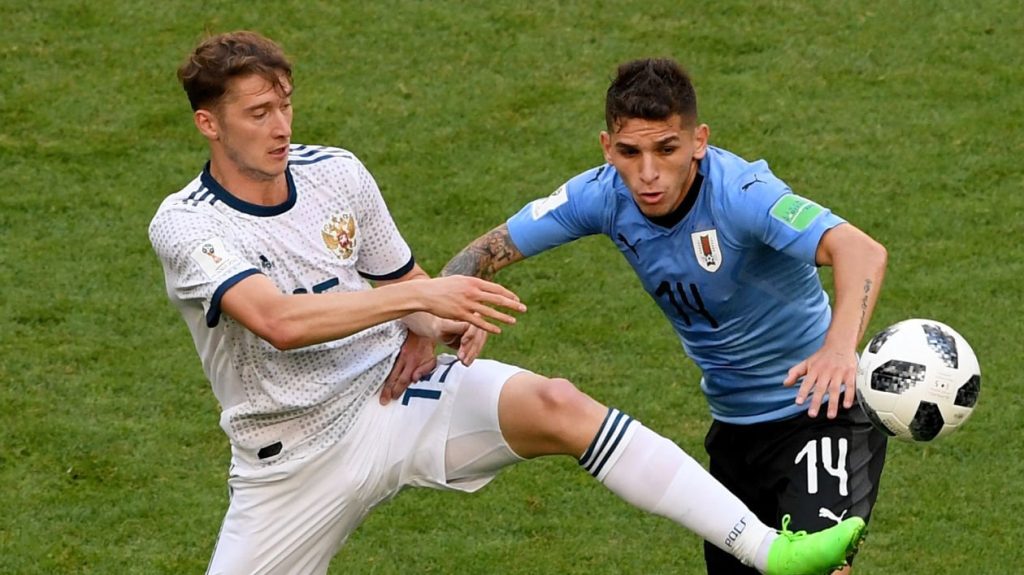
The Russian squad was a perfectly balanced machine built for the big occasion. Aleksandr Golovin operated as the brilliant midfield architect, Artem Dzyuba was an unstoppable physical battering ram upfront, and Denis Cheryshev emerged from the bench to score some of the most spectacular goals of the tournament.
Russia turned their home World Cup into an unforgettable and cinematic epic. They obliterated Saudi Arabia and Egypt in the group stages, but their magnum opus arrived in the Round of 16.
Through an ironclad defensive display and an iconic penalty shootout save by Igor Akinfeev, they eliminated heavily favored Spain. Though they eventually fell to Croatia in the quarter-finals, they transformed absolute national skepticism into pure euphoria.
8. Ghana – Ranked 74th (2026 World Cup)
Ghana’s alarming plunge to 74th in the world rankings is the direct result of a devastating transitional crisis.
Following a string of disastrous, early exits in recent Africa Cup of Nations (AFCON) tournaments, the Black Stars lost a massive amount of ranking points. They entered the 2026 World Cup qualifiers surrounded by intense domestic criticism and a severe lack of confidence.
Unlike the beautifully balanced Ghanaian squads of 2010, the current iteration of the team relies entirely on the individual brilliance of Mohammed Kudus. The West Ham United star is the undisputed talisman, carrying the creative and goal-scoring burden almost single-handedly.
With support from the relentless running of Iñaki Williams, Kudus’s magical left foot dragged a highly flawed team across the qualification finish line.
At the 2026 World Cup, Ghana has presented a highly volatile, entertaining, yet fragile profile. They are entirely dependent on transitional counter-attacks sparked by Kudus.
While they possess the individual firepower to shock anyone on their day, their glaring defensive vulnerabilities prevent them from establishing the commanding presence they once held on the global stage.
8. Nigeria – Ranked 74th (1998 World Cup)
Nigeria’s ranking of 74th heading into France ’98 is arguably the greatest illusion in the history of the FIFA ranking system.
The Super Eagles possessed an absolute “Golden Generation” that had just won the 1996 Olympic Gold Medal. However, because their military government boycotted the 1996 Africa Cup of Nations (AFCON), the team was subsequently banned from the 1998 AFCON. Stripped of opportunities to play competitive continental matches, their ranking points evaporated.
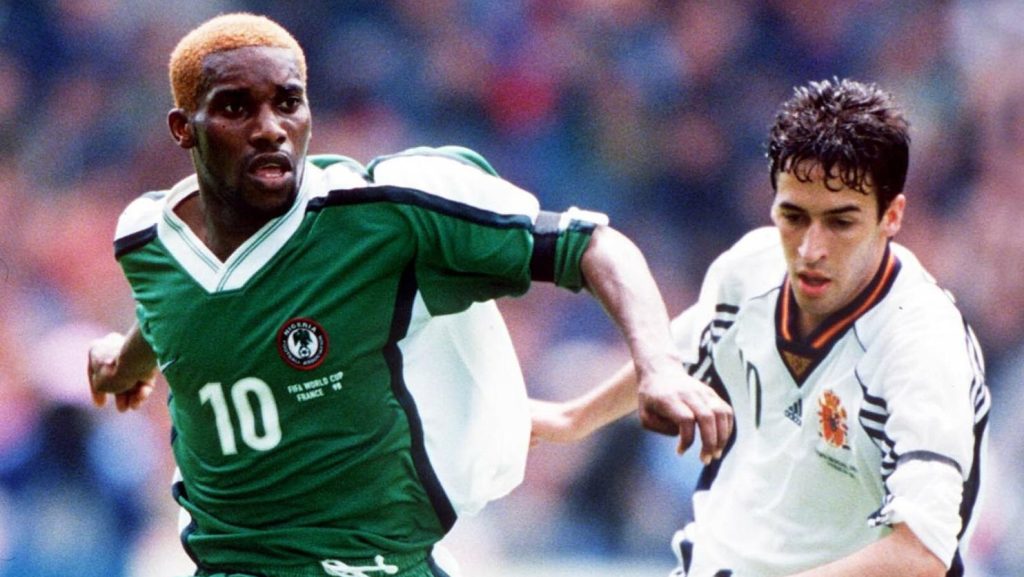
Arriving in France as the 74th-ranked team, they were drawn into a terrifying “Group of Death” alongside Spain, Bulgaria, and Paraguay. Yet, Nigeria unleashed a squad dripping with world-class talent, featuring the magical footwork of Jay-Jay Okocha, the towering presence of Taribo West, and the sheer unpredictability of Nwankwo Kanu.
They immediately orchestrated one of the greatest upsets in World Cup history. Trailing 2-1 against a star-studded Spanish side, Nigeria mounted a ferocious comeback, culminating in a legendary, net-busting thunderbolt from Sunday Oliseh to secure a 3-2 victory.
They topped their group with breathtaking, high-octane attacking football before eventually falling to Denmark. Their ranking was a statistical error; their brilliance on the pitch was undeniable.
6. New Zealand – Ranked 78th (2010 World Cup)
The geographical isolation of the Oceania Football Confederation (OFC) has always been New Zealand’s biggest obstacle in the FIFA rankings. Routinely playing against tiny island nations offers minimal ranking points, resulting in the All Whites arriving in South Africa in 2010 looking like massive statistical underdogs.
They possessed no flashy superstars; their entire philosophy was built upon a colossal impenetrable defensive block orchestrated by captain Ryan Nelsen.
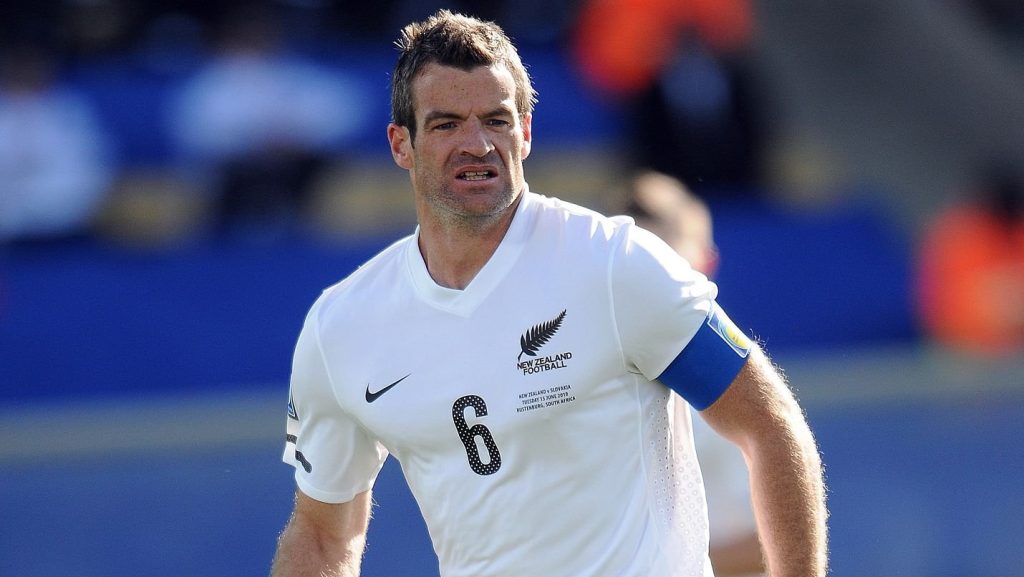
However, this pragmatic approach resulted in one of the most mind-boggling statistics in football history. New Zealand left South Africa as the only undefeated team in the entire 2010 World Cup. While heavyweights like Brazil, Argentina, and even the eventual world champions Spain all suffered defeats, the 78th-ranked All Whites stood completely unbroken.
They achieved this legendary feat by securing three heroic draws in the group stage. They shocked the world with a miraculous 1-1 stalemate against the defending champions, Italy, and stubbornly divided points with Slovakia and Paraguay.
Although they were cruelly eliminated in the group stage due to the math of the points table, they returned home with an immortal legacy that outshone many of the tournament’s giants.
5. Curaçao – Ranked 82nd (2026 World Cup)
For a small Caribbean island with a population of roughly 150,000, being ranked 82nd is actually a massive historical achievement. However, in the context of the World Cup, it makes them one of the lowest-ranked participants ever.
Decades of poor infrastructure and historically low baseline rankings meant Curaçao had to climb a massive mountain just to reach the middle tier of global football.
Their historic qualification for the 2026 World Cup is a fascinating blend of Caribbean flair and strict Dutch tactical discipline. The squad’s backbone is entirely composed of diaspora players born and professionally trained in the Netherlands, such as veteran goalkeeper Eloy Room and the Bacuna brothers.
Under the guidance of Dutch tacticians, they executed a lethal, counter-attacking system to navigate the CONCACAF qualifiers.
Making their debut on the grandest stage, Curaçao is the ultimate fairytale of the expanded 48-team format. They do not rely on a singular star; instead, their strength lies in their European-honed tactical intelligence.
They are a profoundly organized unit, capable of heavily punishing any elite team that underestimates them.
4. South Africa – Ranked 83rd (2010 World Cup)
Similar to Russia, Bafana Bafana plummeted in the rankings due to their status as the 2010 host nation.
Without competitive qualifiers to keep their coefficient afloat, and suffering through a string of underwhelming friendly results, South Africa entered the tournament bearing the heavy, unwanted label of the weakest host nation in modern World Cup history.
The team lacked a truly world-class superstar to carry the tactical burden. While Steven Pienaar provided vital European experience from his time at Everton, the squad’s true superpower was the deafening, relentless energy of the home crowd. They played on pure adrenaline, fueled by the iconic, buzzing roar of the vuvuzelas echoing through the stadiums.
Though they suffered the heartbreak of becoming the first host nation to be eliminated in the group stage, their cultural impact was immortalized. Siphiwe Tshabalala’s spectacular opening goal against Mexico sparked one of the greatest celebrations in sports history.
They concluded their campaign with a massive 2-1 victory over the 2006 finalists, France, ensuring they left their home tournament with dignity and pride.
3. Haiti – Ranked 83rd (2026 World Cup)
Haiti’s presence at the bottom of the FIFA rankings is a tragic reflection of circumstances far beyond the football pitch.
Plagued by devastating natural disasters and severe political instability, the national team was forced to play their “home” qualification matches on neutral grounds. Surviving these logistical nightmares made their journey to the 2026 World Cup nothing short of a miracle.
Their qualification campaign was a testament to raw willpower, spearheaded by the colossal presence of Frantzdy Pierrot. The towering striker utilized his massive physical frame to bulldoze through CONCACAF defenses.
Without the luxury of sophisticated tactical setups, Haiti relied on Pierrot’s target-man abilities and a ferocious, physical intensity to outwork their opponents.
At the 2026 tournament, Haiti has captured the hearts of neutrals everywhere. Every tackle and every sprint carries the emotional weight of a nation enduring profound hardship. They may lack the technical refinement of European powerhouses, but their unbreakable spirit and sheer physical determination make them an incredibly inspiring and uncomfortable opponent to face.
2. New Zealand – Ranked 85th (2026 World Cup)
New Zealand’s appearance at the 2026 World Cup with a ranking of 85 highlights the immediate impact of the tournament’s expansion.
With Oceania (OFC) finally granted a direct, guaranteed qualification slot, the All Whites no longer had to face a grueling intercontinental playoff against a South American or Asian heavyweight. They easily swept aside their regional opposition, but the lack of elite competition kept their FIFA ranking stagnant.
Unlike their heavily defensive 2010 squad, the current New Zealand team is entirely built around the aerial dominance of Premier League veteran Chris Wood. He is the ultimate focal point of their attacks. The tactical blueprint is highly traditional: remain defensively compact, aggressively attack down the flanks, and deliver endless crosses into the box for Wood to attack.
While effective in their region, this one-dimensional reliance on Wood makes them highly predictable at the 2026 tournament. Nevertheless, their distinct physical advantage and traditional British-style approach ensure they remain a stubborn, frustrating obstacle for technically superior teams who struggle to defend aerial bombardments.
1. North Korea – Ranked 105th (2010 World Cup)
The lowest-ranked team to ever participate in a FIFA World Cup arrived wrapped in total mystery.
Due to extreme diplomatic isolation, the Democratic People’s Republic of Korea essentially played zero international friendlies against teams outside their immediate sphere, causing their FIFA ranking points to completely freeze. Entering the 2010 World Cup ranked 105th in the world is a bizarre statistical anomaly that will likely never be repeated.
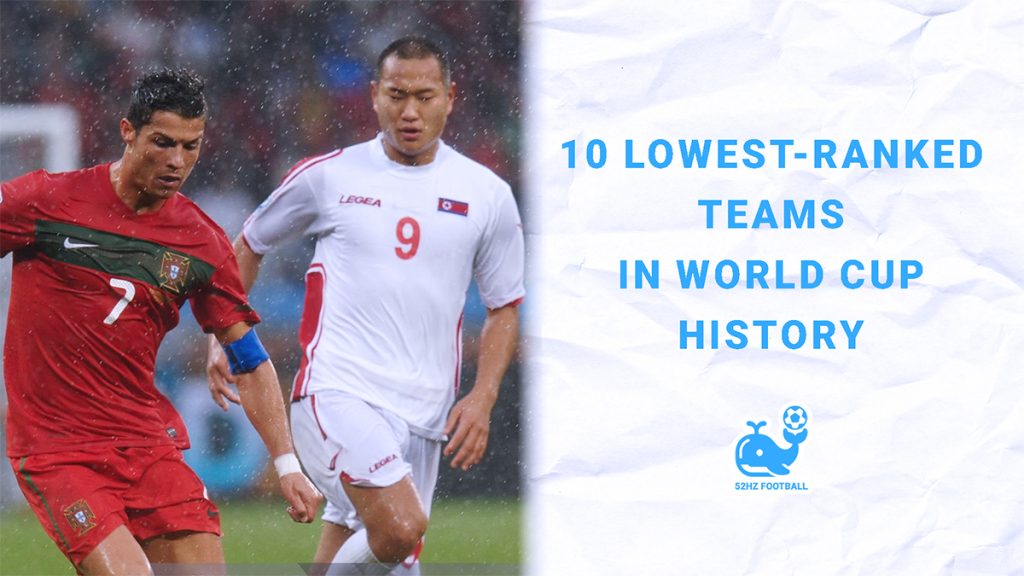
The team operated with intense, militaristic discipline, completely prioritizing the collective over the individual. Their only internationally recognized player was Jong Tae-se, a Japan-born forward dubbed the “People’s Rooney”. The image of him weeping uncontrollably during the North Korean national anthem before their opening match remains one of the most raw, unforgettable moments in World Cup history.
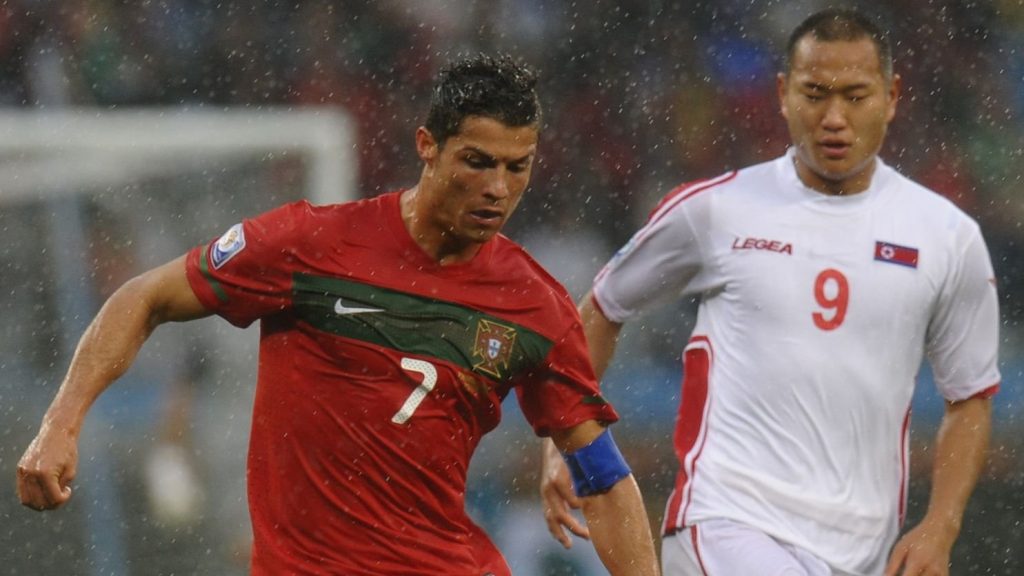
On the pitch, they delivered a monumental shock in their first game. Deploying an impossibly tight defensive formation, they bravely held their own against the number-one ranked team in the world, Brazil, ultimately falling to a highly respectable 2-1 defeat.
Unfortunately, the fairytale ended violently in their next match, where they collapsed to a 7-0 defeat against Portugal, exposing the massive gulf in class. Despite the heavy losses, their opening performance remains a legendary tale of absolute underdogs fighting against impossible odds.
FAQ
Q: Why do host nations often drop significantly in the FIFA rankings before a World Cup?
A: Because host nations automatically qualify for the tournament, they do not participate in their region’s competitive qualification matches. The FIFA ranking algorithm awards significantly more points for competitive fixtures than for international friendlies. As a result, host nations naturally lose ground to teams that are actively winning high-stakes qualifiers.
Q: Has a team ranked outside the top 60 ever won a World Cup match?
A: Yes! Several have achieved this feat. A notable example is South Africa (ranked 83rd at the time), who famously defeated 2006 finalists France 2-1 during the group stages of the 2010 World Cup.
Q: How did the 2026 World Cup expansion affect the rankings of participating teams?
A: The expansion from 32 to 48 teams opened the door for nations from smaller confederations (like OFC and CONCACAF) to secure guaranteed qualification slots. Because these teams often play against lower-ranked regional opponents rather than elite European or South American squads, it is now much more common to see teams ranked in the 70s or 80s appearing at the World Cup finals.
You have just read the article “Ranked 105th?! 10 Lowest-Ranked Teams in World Cup History”. Follow 52Hz Football for more captivating stories, tactical analyses, and historical football deep-dives.
READ MORE:
The David vs. Goliath Effect: 10 Smallest World Cup Nations by Population (2026 Update)
