Uniqlo has spent years around elite sport, working with famous athletes and appearing in football programmes across Japan and the United States.
It has even produced uniforms worn in a professional match, yet finding a club that regularly carries the Uniqlo name is more complicated than expected.
So, does Uniqlo sponsor any football clubs, or has its role in the game been misunderstood? The answer depends on the difference between a club sponsor, a technical supplier and a partner for one-off football events.
Last updated: 22 September 2026.
Does Uniqlo Sponsor a Football Club?
No prominent professional club currently uses Uniqlo as its main kit manufacturer or shirt sponsor.
Uniqlo does not produce a club’s home, away and third kits across an entire season. Its logo is also not displayed on the front of the shirt of a major team in the Premier League, La Liga, Serie A, Bundesliga or Ligue 1.
Its involvement in football has instead taken several different forms:
| Type of partnership | Uniqlo’s involvement |
|---|---|
| Major club technical supplier | No current deal |
| Club front-of-shirt sponsor | No prominent current deal |
| Special football event partner | Yes |
| Youth football sponsor | Yes |
| Community football sponsor | Yes |
| Producer of match uniforms | Yes, for a special event |
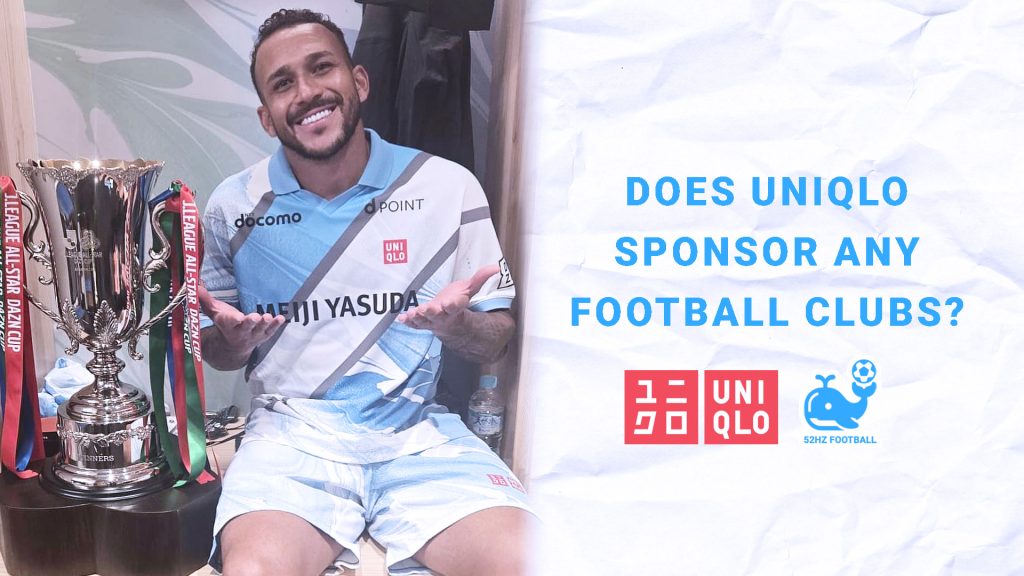
The closest Uniqlo has come to operating as a conventional football kit brand was its involvement in the 2026 J.League All-Star DAZN Cup.
View this post on Instagram
Why Did Jogarbola’s Old Logo Look Like Uniqlo?
Football supporters in Vietnam may have noticed that the former square logo of Jogarbola looked surprisingly similar to Uniqlo’s branding.
Both identities placed white lettering inside a red block, giving them a similar appearance when displayed on a football shirt. However, the two Japanese brands are separate companies and there is no known commercial connection between them.
The square Jogarbola logo was used specifically in the Vietnamese market. In 2024, the company introduced its international petal-shaped symbol on the Vietnam national team’s clothing, replacing the older square design on those products.
The resemblance may have caused some confusion because Jogarbola is a genuine football equipment brand. Unlike Uniqlo, it supplies match kits and other football products to teams in Vietnam and Japan. More information about its current products and partnerships can be found through Jogarbola Vietnam.
Uniqlo and the 2026 J.League All-Star DAZN Cup
Uniqlo took a significant step into professional football in 2026 by becoming the official uniform partner of the J.League All-Star DAZN Cup.
The company supplied the outfield and goalkeeper uniforms worn by the six regional All-Star teams. It was also named a Gold Partner of the wider J.League All-Star event.
This was more than a casual fashion collaboration. The uniforms were worn in competitive action and used Uniqlo’s moisture-wicking DRY-EX material. Replica versions were subsequently made available to supporters through the Uniqlo and J.League online stores.
🇯🇵 J.League All-Star DAZN Cup 2026 kits x Uniqlo
Designed by Francesco Risso, the shirts feature a traditional marbled pattern known as “suminagashi.”
The jerseys symbolize a collective gratitude to everyone who supports the league.
To top it off, there is a special Captain… pic.twitter.com/TItTtvUdU3
— Soccer Jersey News (@soccerjerseynws) May 12, 2026
Designer Francesco Risso created the shirts around a theme of gratitude towards the clubs, players, staff and supporters who had contributed to Japanese professional football.
The patterns were inspired by suminagashi, a traditional Japanese ink-marbling technique. Six colourways were produced to represent the J1, J2 and J3 regional groups taking part in the tournament.
However, the agreement covered one special competition. Uniqlo did not replace the existing kit suppliers of the 60 individual J.League clubs. Full details and images of the uniforms were published on the official J.League website.
Uniqlo Has Supported Youth Football Since 2003
Uniqlo’s relationship with football began long before the 2026 All-Star event.
The company has sponsored the JFA UNIQLO Soccer Kids programme since 2003. Operated by the Japan Football Association, it organises small-sided football festivals for children aged six and under.
Participants receive original Uniqlo uniforms and play on official football pitches. The programme is intended to introduce young children to exercise, teamwork and the enjoyment of playing football.
It is a long-running football sponsorship, but it is a grassroots partnership with a national association rather than a commercial agreement with an individual club.
The difference explains why Uniqlo may appear in searches for football sponsors even though its logo is rarely seen on professional club shirts. The programme is included among the sports projects supported by Fast Retailing, Uniqlo’s parent company.
The Homeless World Cup and Street Soccer USA
Uniqlo has also used football as part of its community work outside Japan.
At the 2024 Homeless World Cup in Seoul, the company provided 1,000 DRY-EX shirts for more than 450 staff members and volunteers. Its American business also supported Team USA through Street Soccer USA, supplying jerseys and travel clothing.
Street Soccer USA uses football-based programmes to support young people living in disadvantaged communities. Uniqlo USA has worked with the organisation since 2013.
These projects show where football fits most naturally within the company’s wider strategy. Uniqlo generally uses sport to promote participation, inclusion and practical clothing rather than focusing entirely on exposure from an elite club.
Uniqlo published further details about its involvement on the company’s official Homeless World Cup announcement.
Why Does Uniqlo Not Make Kits for Major Football Clubs?
The main reason is that Uniqlo is not primarily a specialist sportswear company.
Its identity is built around LifeWear: simple and practical clothing intended for everyday use. Products such as Heattech, AIRism and lightweight down jackets are much more important to its business than football boots or replica shirts.
A major technical supplier must provide far more than the 11 shirts worn by the first team. A typical agreement may include:
- Home, away and third kits.
- Goalkeeper uniforms.
- Training and travel clothing.
- Academy and women’s-team kits.
- Clothing for coaches and other staff.
- Replica products for supporters.
- International manufacturing and distribution.
Specialist brands such as Nike, Adidas and Puma already have the departments, supply chains and football marketing networks required to deliver those products every season.
The largest clubs can also demand substantial guaranteed payments, royalties and performance bonuses. Uniqlo can reach football supporters through limited collections and one-off events without accepting the costs of a full technical partnership.
Why Does Uniqlo Prefer Individual Athletes?
Uniqlo has traditionally concentrated its sports marketing on individual athletes, especially in tennis.
Roger Federer is its best-known global sporting ambassador, while Kei Nishikori has maintained a long relationship with the company. These partnerships allow Uniqlo clothing to appear in major competitions without requiring the brand to supply an entire club or league.
An individual ambassador can also be connected directly to the qualities Uniqlo wants to promote: simplicity, comfort, longevity and personal style.
Football club sponsorship is less controlled. A deal involves large squads, multiple teams, competing commercial partners and results that can quickly change how a club is perceived.
Is Uniqlo a Football Kit Brand?
Not in the traditional sense.
The J.League All-Star uniforms demonstrated that Uniqlo can produce clothing suitable for a professional football match. DRY-EX already provides several of the features expected from modern sportswear, including moisture management and quick drying.
Nevertheless, one tournament does not create a complete football division.
Uniqlo does not currently offer the full range of club shirts, shorts, socks, goalkeeper kits, training products and boots associated with a specialist football manufacturer. It is better described as an occasional football apparel partner than a dedicated kit brand.
Could Uniqlo Sponsor a European Football Club?
A future partnership is possible, although a lifestyle agreement appears more likely than a full kit deal.
Uniqlo could potentially work with a European club on:
- Travel clothing for players and staff.
- A limited lifestyle collection.
- Winter clothing and supporter wear.
- A special anniversary shirt.
- Academy or community programmes.
- Clothing linked to a pre-season tour of Japan.
This kind of arrangement would give Uniqlo access to a club’s global following without requiring it to compete directly with established football manufacturers.
The 2026 J.League project may lead to further football collaborations. For now, however, there is no clear indication that Uniqlo intends to become the regular technical supplier of a major European club.
Final Answer
Uniqlo does not currently sponsor a major football club as its regular shirt sponsor or technical kit supplier.
Its football involvement is still considerable. The company has supported the JFA’s youth programme since 2003, worked with Street Soccer USA and the Homeless World Cup, and produced the official uniforms for the 2026 J.League All-Star DAZN Cup.
Uniqlo is therefore involved in football, but mainly through special events, grassroots initiatives and community partnerships rather than a conventional seasonal agreement with one professional club.
You have just read “Does Uniqlo Sponsor Any Football Clubs?” Follow 52Hz Football for more stories about football shirts, sponsorships and the business behind the game.
READ MORE:
7 Forgotten Football Kit Brands: From Liverpool’s Warriors to Bolton’s Reebok
