
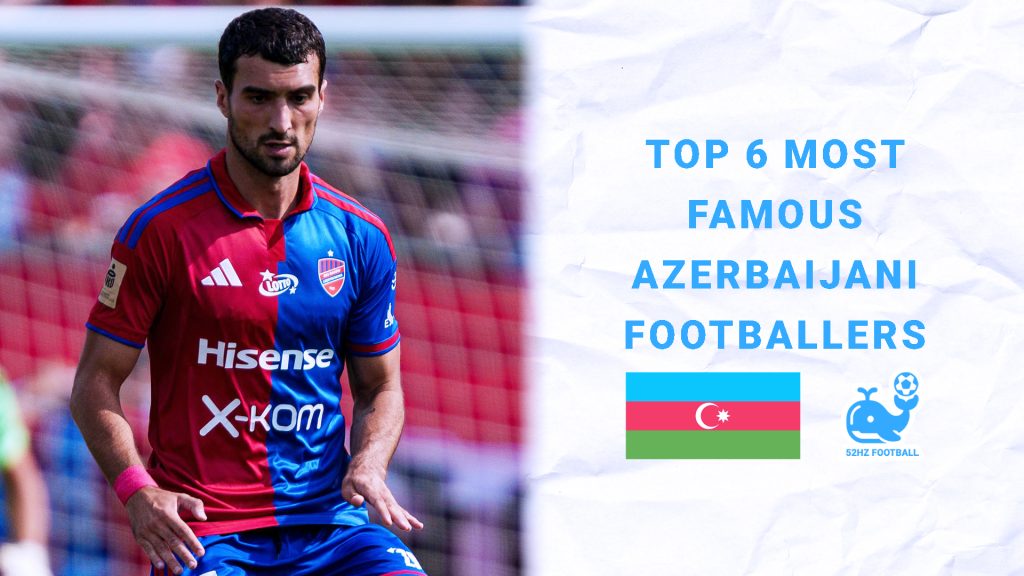
If you are curious about the history of football in the Land of Fire, let’s explore the top 6 most famous Azerbaijani footballers of all time and unpacks the fascinating paradox of a wealthy nation.
The footballing landscape of the Caucasus region presents a fascinating paradox. Armenia has long boasted the talents of Henrikh Mkhitaryan, while Georgia is currently riding the wave of a historic “golden generation” led by global sensations like Khvicha Kvaratskhelia and Giorgi Mamardashvili.
Yet, their neighbor Azerbaijan remains completely devoid of individual superstars. This is a striking anomaly for an oil-rich nation that possesses immense financial resources, successfully co-hosted UEFA EURO 2020 at the magnificent Baku Olympic Stadium, and heavily invests in sports infrastructure.
At the club level, Qarabag FK has become a highly respected continental force, regularly reaching the group stages of the Champions League and Europa League. So, who are the standout figures in a nation with so much funding but so few household names?
This article profiles the top 6 most famous Azerbaijani footballers in history.
Part 1: The Historical Legends
1. Gurban Gurbanov
Long before he became a household name in management, Gurbanov was the most lethal striker in the country. He remains the all-time leading goalscorer for the Azerbaijan national team with 14 goals.
His most iconic international moment came in a memorable 2003 European qualifier, where he scored a stunning brace to sink a star-studded Serbia and Montenegro side.
However, his ultimate fame stems from his managerial career. As the mastermind behind Qarabag FK, he transformed the club into a domestic monopoly. Under his leadership, Qarabag won over 10 league titles and reached the 2017-18 UEFA Champions League group stage, famously holding Diego Simeone’s Atlético Madrid to two draws.
2. Rashad Sadygov
Holding the all-time record for national team appearances with 111 caps, Sadygov is the undisputed defensive rock of Azerbaijani football history. Voted Azerbaijani Footballer of the Year a record six times, he was the heartbeat of the national side for nearly two decades.
Internationally, he is best remembered for scoring a thundering free-kick against Wales in a 2004 World Cup qualifier that left spectators stunned.
At the club level, the commanding center-back spent time in the Turkish Süper Lig with Kayserispor and Kocaelispor. However, his defining legacy was captaining Qarabag through their golden era, leading them onto the pitch during their historic European campaigns.
3. Anatoliy Banishevskiy
Banishevskiy is arguably the only true global superstar born in Azerbaijan. A lethal striker who spent his entire club career at Neftchi Baku, he scored 136 goals and led the club to a historic bronze medal in the 1966 Soviet Top League.
His immense talent earned him a crucial role in the Soviet Union (USSR) national team, where he netted 19 goals in 50 caps. He famously scored a header against Brazil at the iconic Maracanã Stadium in 1965 and represented the USSR at the 1966 FIFA World Cup and two UEFA European Championships (1968, 1972).
In 2004, as part of UEFA’s Jubilee celebrations, he was officially named Azerbaijan’s “Golden Player” as the single most outstanding player the nation produced in the past 50 years.
Part 2: Modern Stars
While the current generation lacks a player in Europe’s elite “Big Five” leagues, several notable names have successfully carved out careers abroad by securing major trophies and scoring on big European nights.
4. Mahir Emreli
Widely considered the most successful attacking export of the current generation, Emreli established himself after winning multiple domestic top-scorer awards with Qarabag.
Seeking a greater challenge, he took the bold step to test his abilities in harder European leagues. He made an immediate impact with Legia Warsaw, where he won the Polish Ekstraklasa and made headlines across the continent by scoring crucial Europa League goals against heavily favored teams like Leicester City and Napoli.
He subsequently moved to Dinamo Zagreb, adding a Croatian title to his résumé, before taking his talents to Konyaspor in Turkey, FC Nürnberg and 1. FC Kaiserslautern in Germany.
Most recently, in July 2026, the 61-time capped Azerbaijan international returned to Poland, joining Raków Częstochowa on loan for the 2026/27 season with an option to buy from Kaiserslautern.
5. Emin Mahmudov
Despite being born in Russia and winning the Russian Youth Championship with the Spartak Moscow academy, Mahmudov chose to represent his ancestral homeland. He quickly established himself as the technical leader and current captain of the national team.
Renowned for his exceptional vision and set-piece prowess, his most viral career moment came in November 2023 during a UEFA Euro 2024 qualifier. In that match, he scored a sensational 45-yard lob over the Swedish goalkeeper to seal a historic 3-0 victory.
Domestically, he has cemented his legacy by becoming Neftchi Baku’s all-time top scorer in European competitions, consistently delivering in crucial European qualifying rounds.
6. Renat Dadashov
A unique case study of immense potential.
Dadashov was developed entirely within the elite German academy systems of RB Leipzig and Eintracht Frankfurt. As a youth player, he was highly touted, scoring prolifically for Germany’s U16 and U17 squads before switching allegiances to Azerbaijan.
Boasting an imposing physical frame, the striker was signed by English Premier League side Wolverhampton Wanderers in 2019.
While he never made a competitive appearance for Wolves, his physical style enabled him to carve out a solid career leading the line across top-flight European leagues, including stints with Tondela in Portugal, Grasshoppers in Switzerland, Hatayspor and Ankaragücü in Turkey, Radomiak Radom and Motor Lublin in Poland.
Part 3: A Global Icon with a Whistle
Perhaps the most fascinating piece of Azerbaijani football trivia is that their most internationally recognized football figure of all time is actually not a player.
Tofiq Bahramov is forever etched into football folklore as the infamous “Russian linesman” from the 1966 World Cup Final. In reality, Bahramov was Azerbaijani.
He famously advised the referee to award Geoff Hurst’s highly controversial “ghost goal”, effectively handing England their only World Cup trophy.
His legacy is so massive in his homeland that the national stadium in Baku – the Tofiq Bahramov Republican Stadium, was officially named in his honor.
Part 4: Why Wealthy Azerbaijan Lacks Football Superstars
Given the nation’s immense oil wealth, state-of-the-art infrastructure, and the massive success of Qarabag FK, the absence of an Azerbaijani Mkhitaryan or Kvaratskhelia remains a glaring anomaly. Several systemic factors explain this developmental bottleneck:
- The “Golden Cage” of Domestic Salaries:
Ironically, the wealth of the domestic league actively hinders long-term player development. Top Azerbaijani clubs, heavily backed by state and corporate funds, can afford to pay their local stars lucrative salaries.
Consequently, young talents often lack the financial hunger or incentive to step out of their comfort zone, move abroad, and battle through the physically demanding, lower-paying leagues of Western Europe to hone their craft.
- Top-Heavy Infrastructure Investment:
While Azerbaijan has successfully spent billions on world-class venues like the Baku Olympic Stadium to host mega-events like UEFA EURO 2020 and the 2019 Europa League Final, grassroots investment has historically lagged.
Resources are heavily concentrated at the professional level, meaning youth academies – especially those outside the capital city of Baku – often lack the elite coaching, modern sports science, and scouting networks required to mold raw talent into world-class ability.
- The “Foreign Import” Illusion:
The immense continental success of Qarabag FK has partially masked the national team’s developmental issues.
Qarabag competes at the highest level of European football by cleverly blending a core of solid, disciplined local players with highly technical, difference-making foreign imports (typically from Brazil, France, and Spain).
While this brings incredible club glory and raises the league’s profile, it relies on imported brilliance rather than producing world-class domestic individuals.
Frequently Asked Questions (FAQ)
Q: What is the highest FIFA ranking ever achieved by the Azerbaijan national team?
A: The highest FIFA world ranking in the history of the Azerbaijan national team is 73rd. They achieved this historic milestone in July 2014 under the guidance of former German World Cup-winning manager Berti Vogts. In recent years, they have typically fluctuated outside the top 100.
Q: Has any Azerbaijani player ever played in the English Premier League?
A: To date, no Azerbaijani player has ever made a competitive appearance in the English Premier League.
The closest to achieve this was striker Renat Dadashov, who signed a permanent contract with Wolverhampton Wanderers in 2019. However, he was immediately sent out on loan and never played a single minute for the Wolves first team.
Q: Why is Qarabag FK so successful in Europe if the national team struggles?
A: Qarabag’s continental success is built on a completely different model than the national team. Their dominance stems from rock-solid financial backing, incredible managerial consistency (Gurban Gurbanov has been in charge since 2008), and a highly effective scouting network.
Rather than relying solely on domestic talent, Qarabag imports high-quality foreign players (often from Brazil, Spain, and France) and blends them with the very best Azerbaijani internationals to create a battle-hardened squad.
You have just read the article “Top 6 Most Famous Azerbaijani Footballers. Why Wealthy Azerbaijan Lacks Football Superstars?”. Follow 52Hz Football for more captivating stories about football, geography and culture.
READ MORE:
7 Forgotten Football Kit Brands: From Liverpool’s Warriors to Bolton’s Reebok
How Clubs Actually Pay for Blockbuster Transfers via Bank Loans?
The Hired Guns: Top 10 Purely Naturalized Footballers (0% Ancestry)
