
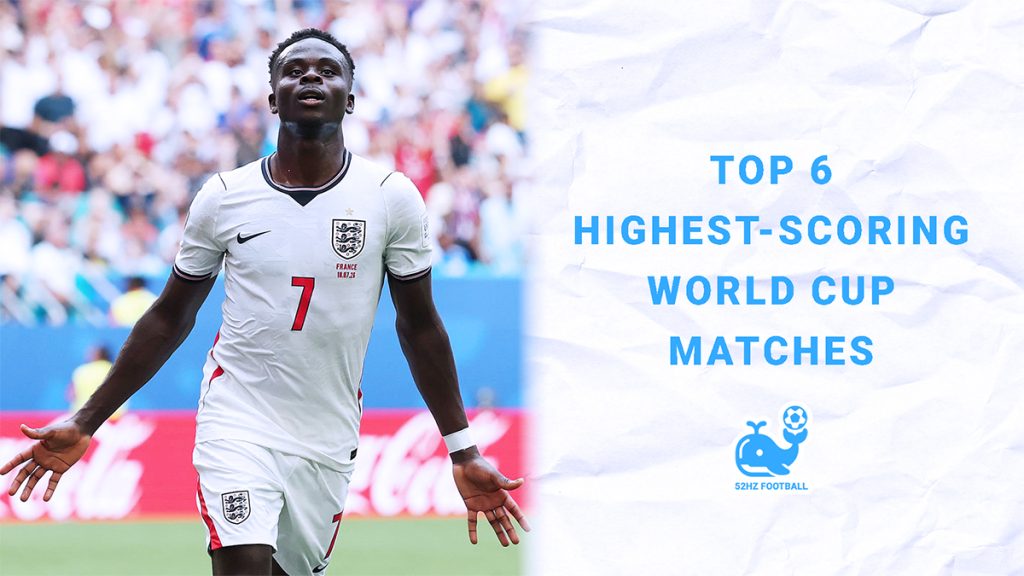
The absurd defensive collapse seen in the recent England 6-4 France has forced a rewrite of the record books, cementing this 10-goal spectacle among the highest-scoring World Cup matches of all time.
When fans tune into the FIFA World Cup, they expect tactical masterclasses, and unforgettable moments. However, every so often, the tactical rulebooks are entirely abandoned, and audiences are treated to absolute goal fests.
The recent 2026 World Cup third-place play-off between England and France shocked the globe, delivering a staggering 10 goals in a single fixture.
6. France 7-3 Paraguay (10 Goals)
- France: Just Fontaine (24′, 30′, 67′), Roger Piantoni (52′), Maryan Wisnieski (61′), Raymond Kopa (70′), Jean Vincent (83′).
- Paraguay: Florencio Amarilla (20′, 44′ pen), Jorge Lino Romero (50′).
During the group stages of the 1958 World Cup in Sweden, France and Paraguay engaged in an incredibly attacking contest. This match is historically significant because it served as the launching pad for legendary French striker Just Fontaine.
Fontaine secured a brilliant hat-trick in this fixture, setting the tempo for what would become an untouchable individual record: 13 goals in a single World Cup tournament.
Paraguay showcased immense fighting spirit in the first half, but the sheer offensive firepower of the French side eventually overwhelmed their defensive lines in the second half.
5. England 6-4 France (10 Goals)
- England: Declan Rice (3′), Ezri Konsa (18′), Bukayo Saka (37′, 45+1′, 87′ pen), Jude Bellingham (90+8′).
- France: Kylian Mbappé (48′, 66′), Bradley Barcola (54′), Ousmane Dembélé (90+6′).
The 2026 World Cup third-place play-off immediately cemented its place in the history books as the most prolific game of the modern era.
Taking place after both teams suffered heartbreaking semi-final defeats, all tactical rigidity was thrown out the window. England raced to a stunning 4-0 half-time lead before France launched a ferocious second-half comeback.
Bukayo Saka secured a historic hat-trick to keep England ahead, while Kylian Mbappé answered with a ruthless brace. The 10-goal thriller was a sensational spectacle for neutral fans, but a nightmare for defensive purists.
4. Brazil 6-5 Poland (11 Goals)
- Brazil: Leônidas (18′, 93′, 104′), Romeu (25′), Perácio (44′), Roberto (71′).
- Poland: Fryderyk Scherfke (23′ pen), Ernest Wilimowski (53′, 59′, 89′, 118′).
Played on a heavily waterlogged pitch in Strasbourg during the 1938 World Cup, this Round of 16 clash is pure footballing mythology.
Poland’s Ernest Wilimowski became the first player in history to score four goals in a World Cup match – yet still ended up on the losing side.
Brazil’s talisman, Leônidas da Silva, known as the “Black Diamond”, scored a hat-trick of his own. Legend has it that Leônidas played a portion of the match barefoot because his boots were stuck in the thick mud, though the referee eventually forced him to put them back on.
It was a chaotic, end-to-end battle that defined pre-war football.
3. Hungary 8-3 West Germany (11 Goals)
- Hungary: Sándor Kocsis (3′, 21′, 67′, 78′), Ferenc Puskás (17′), Nándor Hidegkuti (50′, 54′), József Tóth (73′).
- West Germany: Alfred Pfaff (25′), Helmut Rahn (77′), Richard Herrmann (81′).
In the 1954 group stages, the “Mighty Magyars” of Hungary demonstrated exactly why they were the most feared team on the planet.
Fielding a revolutionary tactical system, Hungary tore West Germany to shreds, with Sándor Kocsis netting four times. West Germany’s manager, Sepp Herberger, fielded a heavily rotated side, accepting the group stage defeat to preserve his main squad.
This tactical gamble paid off miraculously when the two sides met again in the tournament’s final, where West Germany famously enacted “The Miracle of Bern” by defeating the seemingly invincible Hungarians 3-2.
2. Hungary 10-1 El Salvador (11 Goals)
- Hungary: Tibor Nyilasi (4′, 83′), Gábor Pölöskei (11′), László Fazekas (23′, 54′), József Tóth (50′), László Kiss (69′, 72′, 76′), Lázár Szentes (70′).
- El Salvador: Luis Ramírez (64′).
The 1982 World Cup witnessed the most lopsided victory in the history of the tournament.
El Salvador, suffering from administrative chaos and exhaustion prior to the tournament, was simply no match for the European side. The most remarkable aspect of this 11-goal fixture was the performance of Hungarian substitute László Kiss.
Coming off the bench in the second half, Kiss scored a hat-trick in just seven minutes – the fastest hat-trick in World Cup history and the only one ever scored by a substitute.
1. Austria 7-5 Switzerland (12 Goals)
- Austria: Theodor Wagner (25′, 27′, 53′), Alfred Körner (26′, 34′), Ernst Ocwirk (32′), Erich Probst (76′).
- Switzerland: Robert Ballaman (16′, 39′), Josef Hügi (17′, 19′, 58′).
Known as the “Hitzeschlacht von Lausanne” (The Heat Battle of Lausanne), this 1954 quarter-final holds the unbreakable record for the most goals in a World Cup game.
Played in blistering 40°C (104°F) heat, the extreme weather severely impacted the players’ cognitive and physical abilities.
Switzerland stormed to an early 3-0 lead within 19 minutes, but the Austrian side retaliated with five goals in the first half alone. The Swiss goalkeeper, Eugene Parlier, reportedly suffered severe hyperthermia during the match, completely losing his spatial awareness, which contributed to the staggering 12-goal tally.
Why Historic World Cups Were Goal Fests
Looking at the list of the highest-scoring World Cup matches, a distinct pattern emerges: almost all of them occurred in the 20th century, particularly during the 1930s and 1950s. This discrepancy is not a coincidence; it is a direct reflection of the tactical evolution of the sport.
The Era of “All-Out Attack”
In the early days of the FIFA World Cup, tactical formations heavily favored offensive play. Teams regularly utilized the classic 2-3-5 formation, meaning five dedicated forwards were constantly attacking just two defenders.
Defensive strategies like zonal marking, offside traps, and synchronized pressing had not yet been invented. Football was viewed as a game of individual flair and attacking dominance, resulting in wide-open spaces, high scores, and chaotic scorelines like 7-5 or 8-3.
🇭🇺 Hungary had thrashed West Germany 8-3 in the group stage, were on a 30-game unbeaten run and raced into a 2-0 lead in the 1954 #WorldCup final 🏟️
🌧️ In ‘Fritz Walter weather’, however, the West Germany icon inspired the ‘Miracle of Bern’ 🏆@DFB_Team_EN | #OnThisDay pic.twitter.com/UThexMPOwG
— FIFA World Cup (@FIFAWorldCup) July 4, 2021
The Rise of Modern Pragmatism
As we moved into the 21st century, the stakes of the World Cup grew astronomically.
Football evolved into a highly analytical, possession-based, and defensively rigorous sport. Modern managers prioritize “not losing” before trying to win. The implementation of low blocks, defensive midfield pivots, and elite athletic conditioning means that spaces are incredibly tight.
In today’s knockout stages, a single goal is often enough to secure progression, and teams will aggressively shut down a game once they take the lead.
The 2026 Anomaly: Why Did England and France Score 10 Goals?
In the context of modern defensive rigidity, the England 6-4 France result is an absolute statistical anomaly. To see 10 goals in a 21st-century match between two elite, tactically disciplined nations is unheard of.
The reason for this extreme outlier lies purely in the nature of the fixture: the third-place play-off. Following semi-final heartbreak, both teams entered the pitch with zero tactical pressure and a distinct lack of defensive motivation.
The match devolved into a highly entertaining, but tactically flawed, exhibition game. Defenders abandoned their strict positioning, midfielders skipped their tracking-back duties, and attackers were given the freedom to play street football.
It was a rare glimpse of 1950s-style football transported into the year 2026 – a highly unusual, but wildly entertaining, glitch in the modern football matrix.
The Highest-Scoring World Cup Matches of the 21st Century
While double-digit scorelines are mostly relics of the past, the 21st century has still provided a few jaw-dropping goal fests, usually the result of massive skill disparities in the group stages or unprecedented collapses. Here are the very few modern games that generated 8 or more goals:
- England 6-4 France (10 Goals | World Cup 2026): The third-place play-off exhibition that broke every modern tactical rule, setting a new century record.
- Germany 8-0 Saudi Arabia (8 Goals | World Cup 2002): A brutal group stage mismatch where Miroslav Klose announced himself on the world stage with a hat-trick of headers.
- Brazil 1-7 Germany (8 Goals | World Cup 2014): The infamous “Mineirazo” semi-final. The most shocking result in modern football history, where the host nation completely capitulated under immense pressure.
- England 6-2 Iran (8 Goals | World Cup 2022): A dominant group stage opener in Qatar where England’s youthful attacking lineup ruthlessly dismantled the Iranian defense.
The history of the World Cup is written in goals. While the tactical discipline of the modern era makes games tighter and more tense, anomalies like England vs. France prove that the beautiful game can still surprise us with pure, unadulterated attacking chaos.
You have just read the article “Where England 6-4 France Ranks Among the Top 6 Highest-Scoring World Cup Matches?“. Follow 52Hz Football for more captivating stories, tactical analyses, and historical football deep-dives.
READ MORE:
4 Reasons Why World Cup Should Eliminate the Third-Place Match
